

They call this epic eight-lane blacktop, which slices through the bustling heart of Dubai, the ‘Sheikh Zayed Highway’. A more accurate name would be the ‘Sheikh Zayed Race Track’ because every drive down it feels like a competition: furthermore, one where the drivers are bringing some pretty sharp knives to the fight.
At least that used to be the case until relatively recently, when some killjoys from one of Dubai’s many government departments introduced stuff like speed cameras to take the shine off the Sheikh Zayed Grand Prix.
Still, that hasn’t put many of its drivers off the perennial mission to finish first. If we take Ayrton Senna’s definition of no longer being a racing driver when you see a gap and don’t go for it, the place is still full of future champions (many of whom drive beige Toyota Camry taxis). They just do it slightly more slowly these days.
But the proliferation of those stern grey cameras, and the fact that some people even take notice of them from time to time, is a sign of how the automotive world is changing in Dubai. Not just the automotive world either: they’ve even introduced a nine per cent corporate tax rate over there recently.
At least petrol is still dirt cheap which makes it even more of a mystery to understand why a lot of those taxi drivers are swapping their Toyotas for Teslas.
One by one, the last bastions of automotive freedom are being eroded all over the world. Yes, even in Dubai. People in Dubai talk a lot about rising costs, which is why what they drive is also changing.
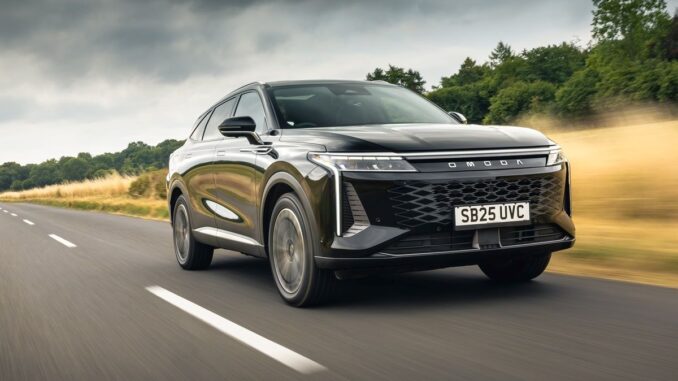
Of course, you’ll still see plenty of V8s and other exotica charging from mall to mall. Yet more and more of the cars of Dubai are becoming more silent and Chinese.
The Chinese car industry now is what the Japanese industry was in the 1970s: a powerhouse of value and efficiency that convinced people who were feeling the pinch to try something different. Many new Chinese cars are also electric, promising what appears to be an unfeasibly long battery range, from brands that you will never have heard of unless you spend a lot of time in Shanghai.
But the really shocking part is that the premium Chinese cars are all actually quite good now: to be a passenger in at least. The leather actually looks and smells like it might have come from a cow. The switches are plastic, feel solid, well-made and almost Germanic. The interiors are staid and sensible, the exteriors generally derivative yet uncontroversial (most are SUVs, looking like a cross between a Lexus and a Range Rover). Their drivers, who generally don’t feel the need to secure a front-row slot on the grid for the Sheikh Zayed Grand Prix, can’t praise them highly enough, often saying they would never go back to a European or Japanese gas guzzler.
So, it almost comes as a relief to know that you can still also buy legions of Chinese cars that are truly awful, looking like they’ve been styled by a one-eyed four-year-old, complete with garish graphics on the dashboard that wouldn’t seem out of place on an Atari console circa 1995.
But these celebrations of automotive mediocrity, complete with slush box mated to a punily asthmatic motor under the tinny bonnet, are fast becoming obsolete.
Soon, we will be flooded with a barrage of inoffensive and competent cars from China that will make a Toyota Prius seem characterful. The warning signs are already there: for the first time in my entire life, I can’t recognise the make and model of a car just by glancing at its profile.
And if this type of vanilla motoring, complete with regulation and law abiding is even catching on in Dubai, what hope has the rest of the world got?
Author Bio:
Anthony Peacock works as a journalist and is the owner of an international communications agency, all of which has helped take him to more than 80 countries across the world.
Photograph courtesy of Omoda UK

Be the first to comment