

There is more to the English county of Dorset than Thomas Hardy, thatched cottages and thatched bus stops. And thatching contractors with two year waiting lists.
There are also crumbled shingle beds, rock doughnuts, a “tombolo”, limestone foldings, a privately owned sea arch, Old Harry and his wives, a “Blind Cow”, a “Nodding Donkey” and a Tower That Moved. As well as the best berry breakfast smoothies in the UK.
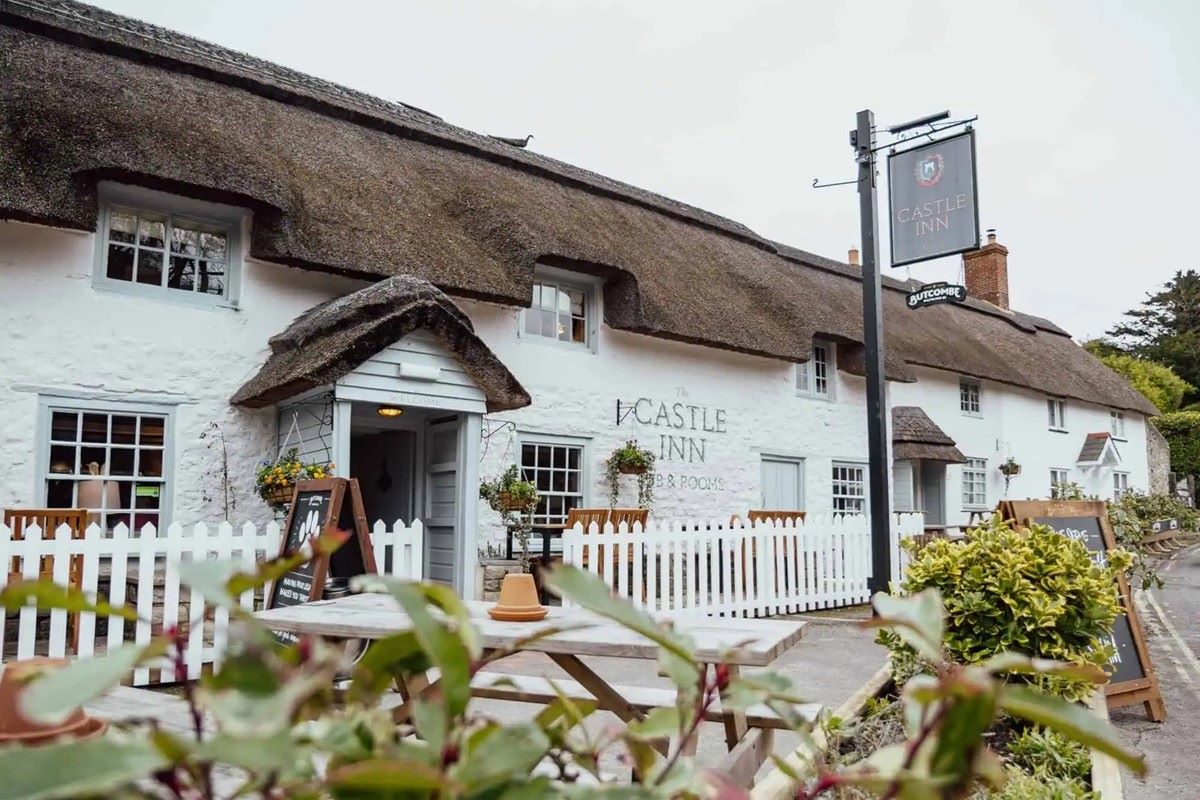
Tim and his team at the neatly and quaintly thatched 17th century Castle Inn in West Lulworth, Dorset provide the latter as well as a friendly base from which to travel back through time.
No time traveller can time travel efficiently without the ballast of a legendary Butcombe loaded bacon butty breakfast washed down by whizzed-up fruit to set them up to take in the view from Heaven’s Gate, walk the Dancing Ledge and brace themselves for some Nordic bathing in the English Channel followed by a £95, 65-minute Seawater Sauna on the beach at Lulworth Cove.
Dorset is the answer to how to fit in 185 million years of history into a week or long weekend.
The Isle of Purbeck boasts the remains of a drowned Jurassic Forest. Circa 144 million years ago the sea levels dropped and islands emerged surrounded by saline lagoons and channels. A tropical forest grew up. It then flooded, leaving the most complete fossilised record of a Jurassic forest in the world with ancient cypress-like trees and the ring doughnut shapes where roots used to grow.
Southern England’s Jurassic Coast, also known as the Dorset and East Devon Coast, stretches 96 miles from Exmouth to Studland Bay in Dorset. It was the first wholly natural World Heritage Site to be designated in the United Kingdom.
What is a headache for most is a windfall for the geologically minded. Rockfalls, landslips, cliff collapses and continuous coastal erosion have exposed an almost continuous sequence of rock formation covering the Mesozoic era and its Triassic, Jurassic and Cretaceous periods.
Beachcombing therefore can turn up anything from an ichthyosaurus skeleton to a plesisaur shin bone.
At different times, as part of the Pangea supercontinent, the area was desert, shallow tropical sea and marsh. The fossilised remains of the various creatures that lived there have been preserved in the rocks. 71 different rock strata have been identified at Lyme Regis.
Before there were such things as palaeontologists, fossils were seen as thunderbolts frozen in rocks and even the devil’s toenails.
Natural Purbeckian features include sea arches and sea stacks such as Old Harry’s rocks at Swanage. Chesil Beach is the local tombolo, an 18-mile barrier ridge made up of 180 billion pebbles. At Orcombe Point, the “Geoneedle” (2002), a pyramidal sculpture, marking the western end of the heritage site, is built from fragments of the different types of rocks for which the coastline is famous.
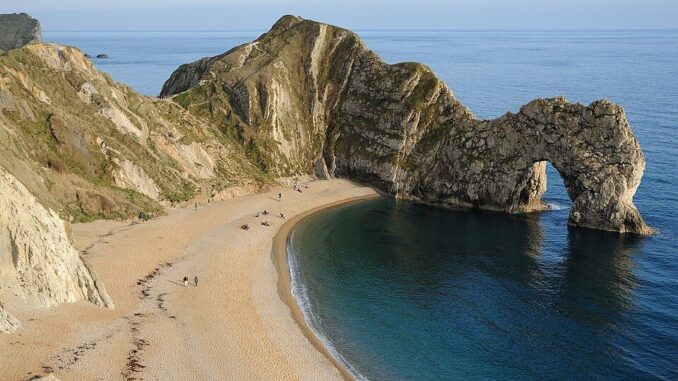
At Lulworth Cove, a short walk from The Castle Inn, the waves have cut through the Portland stone to create a horseshoe-shaped cove. The return walk to the natural limestone arch of Durdle Door is about three hours. The Door is owned by the Weldt family, owners of The Lulworth Estate.
All the rooms at The Castle Inn are named after local Jurassic Coast landmarks, like Dungly Head, although sadly there is no Scratchy Bottom. The cliff top valley between Durdle Door and Swyre Head where Gabrielle Oak’s sheep were driven over the edge in the film “Far From the Madding Crowd”. And the highest point on the Jurassic Coast and on the entire south coast of Britain, is Golden Cap, near Bridport.
Pepler’s Point, the headland overlooking Lulworth Cove, the Stair Hole and the Lulworth Crumple where bands of softer shale collapsed under their own weight, leaving the alternating bands of limestone to topple against one another, honours Sir George Lionel Pepler (1882-1959) who lived at Little Bindon.
A town planner, he drafted the Town and Country Planning Act of 1947, establishing the principles of the green belt and the importance of town planning within communities. He was also active on the Council for the Preservation of Rural England. Grazing cattle are used for local conservation work.
The “Blind Cow” is an offshore rocky outcrop as is “The Bul””. Both can be seen from Man O’ War Cove.
Other places of interest are a tank museum, the Fine Foundation Marine Wildlife Reserve which is the longest established Voluntary Marine Nature Reserve in the UK and the Norman chapel of St Aldhelm, one of the oldest churches in England and named after the Bishop of Sherbourne who died in 709AD.
If debris from concordant and discordant coastlines are your thing, the best places to see the remains of now extinct animals and plants immersed in deposits of mud which later hardened into rock are the Kimmeridge Museum of Jurassic Marine Life and the Dorchester Museum. The town, fictionalized by the novelist and poet Thomas Hardy as Casterbridge. It also has a Teddy Bear Museum.
They both have impressive collections of petrified cycads (ferns), ancient fish and snot lizard teeth, crinoids, cephalopods, dolphin backbone vertebrae, mammoth molars and shoulder blade fragments, deer antler parts, copralites, seed shrimps and veloraptor remains, inferior Oolite formation, chalk ammonites, flint scatters, Eocene clay, Purbeck marble, cretaceous chalk, very ancient pebbles and a lot of unidentified ichnites.
Many of England’s most famous cathedrals have Purbeck marble and, after the Great Fire of London of 1666, much of London was rebuilt in Portland and Purbeck stone. Kimmeridge shale was worked jewellery, decorative panels and furniture by the Romans.
As well its fossil-rich Jurassic shale cliffs, Kimmeridge Bay, four miles from Wareham, is the site of BP’s Nodding Donkey, the oldest continually working oil well in the UK which has been producing oil since 1961.
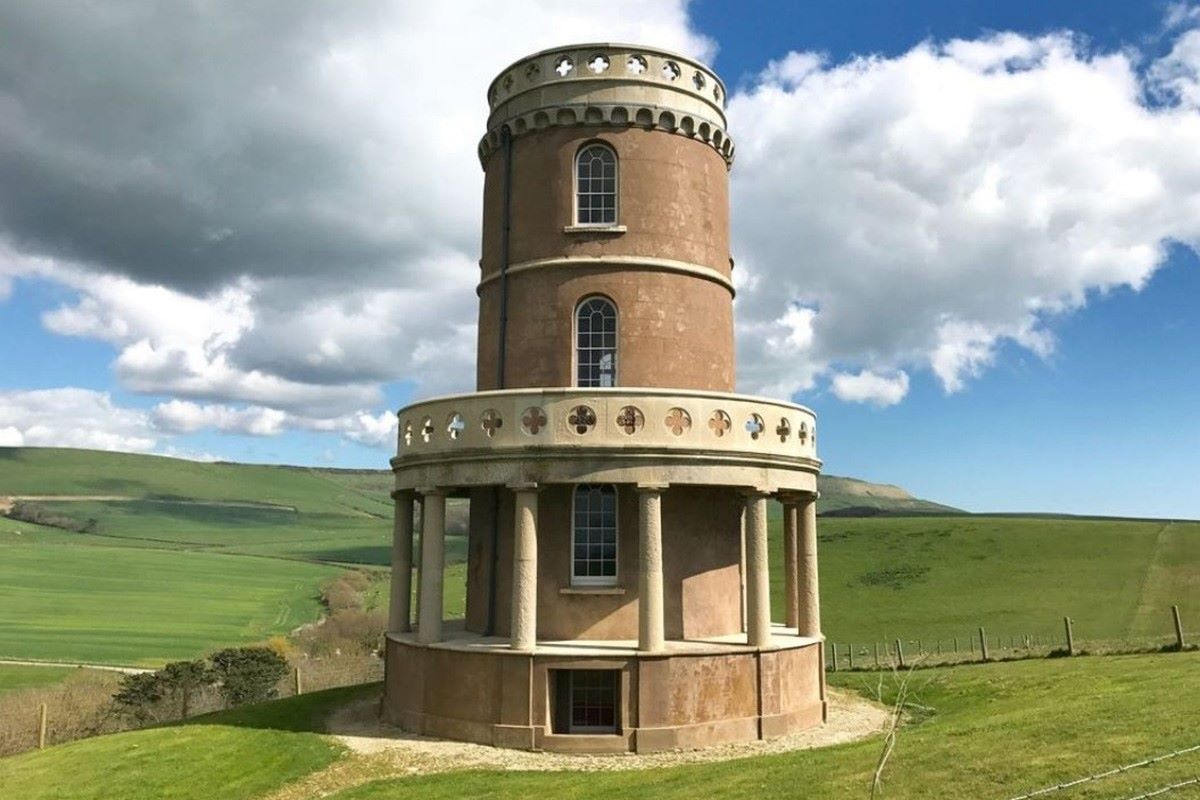
Further landmarks include the Corfe Castle village and 10th century castle and Clavell Tower on Hen Cliff. Originally built by the Rev. John Clavell as an observatory and later used as a lookout, in 2006 the Landmark Trust moved all of its 16,272 stones and reassembled them slightly inland. To save it from coastal erosion.
If you get as far as Chaldon Herring, have a drink at the traditionally thatched Sailor’s Return pub. The National Trust-owned Brownsea Island in Poole harbour was the site of Baden-Powell’s first Boy Scouts camp in 1907. It is also famous for red squirrels.
Dorset also boasts the highest number of species of native and anciently introduced wildflowers of any area of comparable size in Britain. As well as primrose meadows and vetch fields you can spot the Early Spider Orchid. Dorset Heath (Erica ciliaris) – the county flower – which can be found in July and August, especially on Hartland Moor.
Wine lovers should visit Langham Vineyards and Wine Estate at Crawthorne, near Dorchester.
And every guest of The Castle Inn be prepared for good food, great hospitality and the likelihood of an incorrigibly ebullient manager escorting you into the restaurant and, passing a sign for the Cove Room asking: “I don’t think you belong there do you?”
Dorset may be 50,000 thatched roof country and it may be Hardy Country. But it is Cove Country too.
For more information on the Jurassic Coast, please visit: www.visit-dorset.com and www.visitdevon.co.uk.
Author Bio:
Kevin Pilley is a former professional cricketer and chief staff writer of PUNCH magazine. His humour, travel, food and drink work appear worldwide, and he has been published in over 800 titles.
Photographs courtesy of Visit Dorset and Butcombe Pubs & Inns


Be the first to comment