

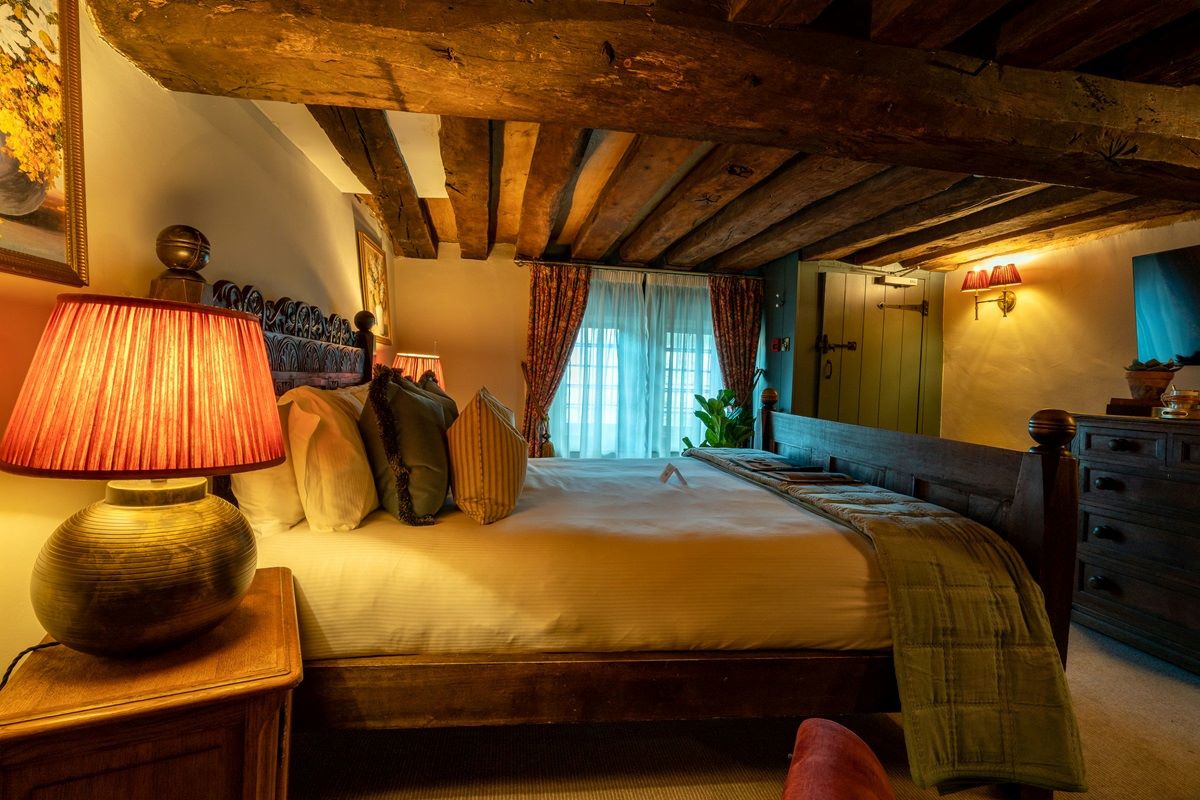
It is rather unsettling undressing in front of a literary icon. But Samuel Pepys, the 17th century English diarist, comes ensuite with a Tudor period staycation in one of the oldest inns in England. From a portrait painting hanging by the bathroom door, his knowing eyes follow you all round ye old worlde bed chamber named after him.
In 1668, Mr and Mrs Pepys visited the George Inn, Norton St Philip in Somerset on their way from Bath to Salisbury. We do not know whether his wife bemoaned the lack of a spa or remarked as mine did that the room was the same colour as our kitchen.
Or whether he had the feeling as I did when Emily, one of the charming and very comely on-site serving wenches, showed us up the creaking turret staircase and opened our room door, was going to say that, if we felt cold. we only had to ring reception, and they would send up a bigger tapestry.
He only mentions visiting the grave of the Maids of Foscot (now Foxote), who were conjoined twins.
He never mentioned the giant plastic Swiss plant I walked into (twice) in the middle of the night or the wonderful beetroot tart starter and haunch of venison followed by chocolate mousse and naughty madeleines with even naughtier rum chocolate dipping sauce dinner prepared by Salon Culinaire Pub Chef of the Year, Aimie Harley and served by Kim and Emily who took it in turns to take away and deliver our plates and keep the inglenook fire banked to crackling point.
Samuel never mentions Butcombe Wednesdays with 25 per cent off all food, either.
Nearly 3,000 pubs have vanished across England and Wales since 2020. In some regions of the UK, one public house closes every day due to rising costs and the beer and spirits.
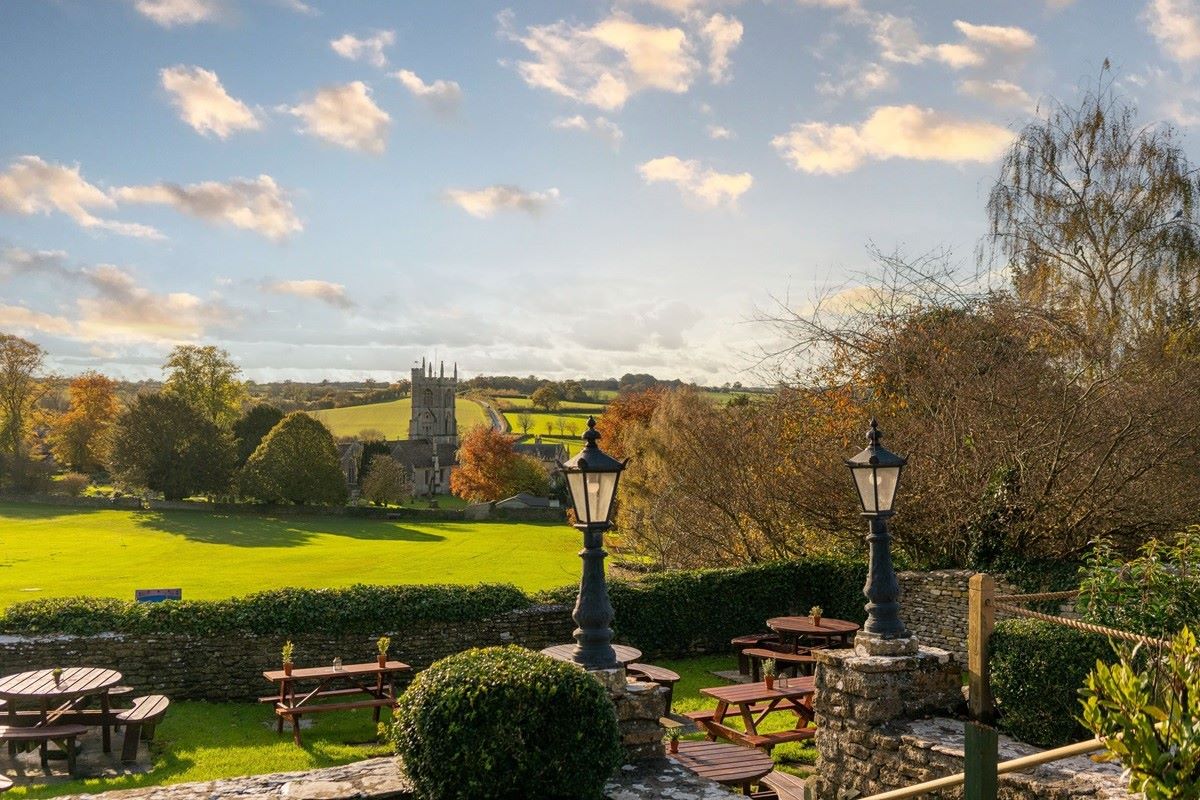
But thankfully the old inns are surviving. Canopied four-poster beds, flagstone floors, mullioned windows, stone fireplaces, exposed oak beams, dungeons, galleried courtyards, cobbled alleyways, double door barrel doorways, 14th century porches, a beer garden overlooking a cricket club and a times-gone-by air are still in demand.
But they are not Ye Olde Worlde anymore. They are now called Boutique. Which means ancient hostelries, age-old watering holes and places of hospitality have been sympathetically reconfigured and lovingly refurbished. And infer that, at around £120 a night excluding dinner, the days of sharing a room with a wool merchant and his family are long over.
The Old Ferry Boat at St Ives in Cambridgeshire has been open since 560 AD. The Porch House, formerly the Royalist Hotel, in Stow-in-the-Wold in the Cotswolds dates from 947 AD. The Trip (or ‘halt’) At Jerusalem (once The Pilgrim) built into the sandstone cliff of Nottingham Castle goes back to 1189, the first year of the reign of Richard the Lionheart. On the old Great North Road, the Angel at Grantham, has been welcoming travellers since 1203. The Royal part was added in 1866, after a visit from the Prince of Wales. The Old Bell Hotel at Malmesbury in Wiltshire goes back to 1220 and is reputed to be England’s oldest purpose-built hotel. Situated adjacent to the magnificent 12th century abbey, it was originally used as a guesthouse for visiting monks.
The Mermaid Inn at Rye in Sussex was built in 1156 and rebuilt in 1420. It too was a resting place on the pilgrimage trail from Winchester to Canterbury. The 600-year-old Crown Inn at Chiddingfold has been an open house since 1383.
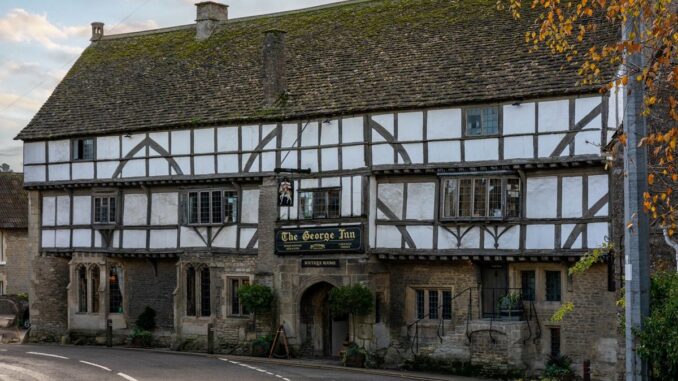
But if you are after a real feel of medieval England and want to stay 300 years back in time, the iconic 13-room George Inn in St Norton St Philip, seven miles from Bath and about the same from Frome, has been serving alcohol since 1397. Governmental licences for alehouses were only introduced in 1552.
According to dendrochronologists and people who know about roof timbers, most of the building is 330 years old and some parts much older.
The George, which was voted AA Inn of the Year in 2024 and 2025, belongs to the Butcombe Brewing Co Boutique Collection which include historic properties, both urban and rural, as well as some thatched properties, such as the 1660 Castle Inn At Lulworth Cove in Dorset, The Swan Inn at Rowberrow, the 15th century Lion Inn in Gloucestershire, the High Corner Inn in the New Forest, Hampshire , Somerset’s 17th century Langford Inn, Wiltshire’s King John Inn, The Trout at Tadpole Bridge on the Thames in Oxfordshire and The Swan Inn in the Mendip Hills. As well as many others. All equally wonderfully atmospheric, warm, friendly and foodie centric.
Built in the 14th or 15th century, as a wool store for the priory at nearby Hinton Charterhouse (one of 10 Carthusian houses) and to accommodate travellers and merchants coming to the annual wool fairs that were held in the village from 1255 until 1902, The George Inn became part of the stage coach route between London and the South West. The infamous Judge Jefferies used the inn as a courtroom during the Bloody Assizes. 12 people were kept in the Inn’s dungeon and executed on the village common. During the Pitchfork Rebellion, it was the HQ of the Duke of Monmouth, the illegitimate son of Charles I who led the rebellion again James IV, the last Roman Catholic monarch. He also has a bedroom named after him.
The inn has eight guest rooms filled with antique furniture and period wall-hangings as well as books. In the Samuel Pepys room, the library comprises of American Notes and Humphrey Clinker’s Clock, Fowler’s Modern English Usage and two books on fly dressing. Which meant I could tuck into Dickens and the wonderful world of syntactical foibles while my wife could find out how to construct a hairy minnow, Black Zulu and a Blue Doctor salmon fly and know what to do with any leftover hen pheasant quills and red cock hen hackle feathers.
There are peaceful walks including down the Kennet Avon Canal and over the Dundas Aqueduct at Limpsley Stoke, where you pass houseboats with names like Tom, Moriarty, Merlin, Eccles Hall, Mooo and Comfortably Numb.
Also nearby are the National Trust village of Lacock, Bradford-on-Avon and Longleat. America is not far away either.
The American Museum and Gardens is a museum of American art and culture based up the road at the ashlar Claverton Manor. Its collections of American furniture, quilts and folk art are displayed in a Grade I listed house surrounded by gardens overlooking the River Avon Valley. Opened in 1961 by English antiques collector John Judkyn and Long Island psychiatrist, Dallas Pratt, heir to a substantial Standard Oil fortune, it remains the only museum devoted to American decorative arts outside the United States.
As well as Revivalist furniture, a late 17th century Puritan home interior, a New Orleans bedroom dating from around the eve of the American Civil War in 1860. The museum also houses antique historical maps and Shaker designs. The 30 acres around the house includes a replica of George Washington’s garden at Mount Vernon, a Lewis and Clark trail and an arboretum of American trees.
Pepys missed much when he was in the area. Today, if he had overnighted at the famous George, he may have left a more detailed account of his stay:
“Blessed be God, these complimentary bathroom Bramley toiletries are fiddly. Why screw them to the wall? You need much index finger strength in order make them to yield the merest dollop of geranium-scented bodywash.
“Woken early by the air brakes of the D2 bus to Bath – three times more startling than a clattering wood wain or cart – we went downstairs in expectation of a loaded bacon butty and locally sourced sourdough bread toast. And were not disappointed. My wife pronounced herself happy with her plant-based breakfast and I with my two chocolate panneaux and Eggs Royale with chalk stream trout. Sam’s service was faultless. We talked basely about Travelodges.
“Thence, we made a sedate circuit of the quaint cricket field before my wife proved herself superior at skittles at which I am pants. The Fleur de Lys is across the crossroads from The George.
“Afterwards, we enjoyed marvellous discourse with Mike, formerly manager at Bath Rugby Club and now in charge of the cellars and dray deliveries. Between us, we came up with an infinity of words for the English cricket team.”
If Posterity would wish to know where I would choose to stay anywhere near the Royal Crescent and Thermae it would be the grand old George. And old England. One night was memorable and insufficient although it did cause in me apprehensions that my room may be haunted by a snoring ghost. For, hand on heart, Mrs P confesses she doesn’t snore.
Otherwise, we left in very good cheer, exceedingly satisfied and well-supped. our souls rejoicing in the good fortune that good British pubs still exist. Although watching midweek football from a four-poster bed is not recommended.
An uninterrupted view of the final third and goalmouth action is often not guaranteed.
The Details
The George Inn, Norton St Philip, High Street, Bath, Somerset, BA2 7LH, England.
Tel: +44 (0)1373 834224
Website: www.butcombe.com/the-george-inn-somerset
Email: georgeinn@butcombepubs.com
The closest train stations are Bath and Frome, both a 20 minute drive from the Inn. If you are driving, there is complimentary parking available.
Type of Hotel: Old English Inn (Pub with Rooms)
Number of Rooms: 13 rooms divided between the Inn and The Plaine over the road.
Price Band: Medium, from £120 per night.
Insider Tip: You must try The Pie of The Week.
Reviewer’s Rating: 8/10
Author Bio:
Kevin Pilley is a former professional cricketer and chief staff writer of PUNCH magazine. His humour, travel, food and drink work appear worldwide, and he has been published in over 800 titles.
Photographs courtesy of The George Inn

Be the first to comment