

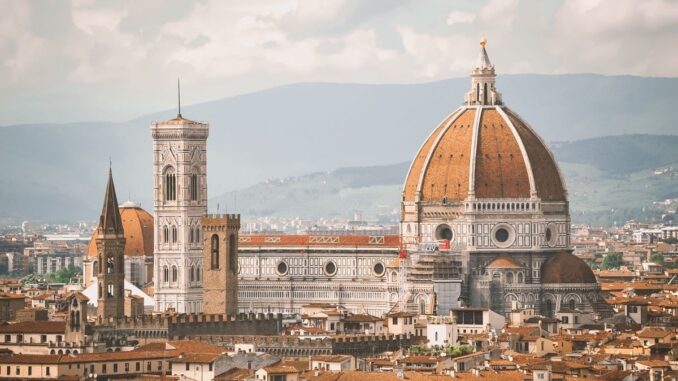
Most painters have to share a city. Sandro Botticelli more or less owns a corner of Florence.
He was born there around 1445 on a street called Borgo Ognissanti. Apart from some months working in Pisa and a spell in Rome painting the walls of the Sistine Chapel, he never really left. He lived, worked and was buried within the same few streets.
That makes him an unusually easy artist to follow on foot. It’s also a good moment to do it because in June 2026 the Uffizi unveiled a complete redesign of the rooms that hold his best-known work. Here is how to spend a day in his company.
The tanner’s son called ‘little barrel’
His real name was Alessandro Filipepi, and his father was a tanner. Botticelli was a nickname meaning ‘little barrel’. It belonged first to his older brother Giovanni, apparently on account of his round build, and by 1470 it had stuck to Sandro as well.
He trained under Fra Filippo Lippi, one of the leading painters in the city and a favourite of the Medici. That connection shaped the rest of his career, as the first stop in the gallery shows.
Start with the painting that caused a row
Before the famous rooms, look for a tall panel of a young woman in armour. This is Fortitude, and the Uffizi calls it Botticelli’s first documented work.
It came with an argument attached. In 1469 a painter called Piero del Pollaiolo was commissioned to paint a set of Virtues for the hall of the city’s merchants’ court. One of the figures was then handed to the young Botticelli, thanks to his links with the Medici side. Pollaiolo protested, understandably, and Botticelli was kept to this single panel.
You can still tell it apart from the others. It’s painted on poplar where the rest are on cypress, and her marble seat is more richly decorated. Her face already has the dreamy, slightly sad look that would become his signature.
Spot the painter in the crowd
The Adoration of the Magi was painted for a chapel in the church of Santa Maria Novella and it made his name. It’s a Bible scene on the surface. Underneath, it’s a group portrait of the people who ran Florence.
The old king kneeling before the child has the face of Cosimo de’ Medici, at least according to the 16th century writer Giorgio Vasari. The dark-haired young man on the right is probably Lorenzo the Magnificent. The white-haired man in pale blue, pointing at himself, is the businessman who paid for it all.
Now find the blond young man at the right-hand edge, staring straight out of the picture. That may well be Botticelli himself.
Two goddesses, face to face
Then come the two paintings everybody is here for. Since the redesign, Primavera and the Birth of Venus hang facing one another for the first time. The bulky outer glass screens have gone, replaced by airtight display cases and the walls are a very pale grey.
Primavera is the older of the two, painted around 1480 on poplar wood. It once hung in a Medici town house above a piece of furniture, a sort of chest with a back. Look down at the lawn. At least 42 species of plant have been identified in it.
The Birth of Venus, from around 1485, is on canvas. The title is misleading because the goddess isn’t being born. She’s arriving on the island of Cyprus, blown ashore by the winds. Her hair really does shine as it was touched with gold.
Two round paintings of the Madonna now hang either side of her. Compare the faces of the Virgin and the goddess. The likeness is deliberate on the gallery’s part, and it’s rather startling once you see it.
The last word
The sequence ends with a much smaller picture, the Calumny of Apelles, painted around 1495. Read it from right to left. A king with donkey’s ears sits in judgement while an innocent man is dragged before him by the hair. Truth stands to one side, naked and ignored.
It dates from the years when the age of Lorenzo was over, and the preacher Savonarola held sway in Florence. It was the last time Botticelli painted a subject of this kind.
Walk to his church
Leave the gallery and follow the river west to the church of Ognissanti in the neighbourhood where he grew up.
On the wall of the nave is his fresco of St Augustine, painted in 1480 for the Vespucci family. They were his neighbours and the family of Amerigo Vespucci, whose name ended up on two continents. Directly opposite is a St Jerome by his rival Domenico Ghirlandaio, painted at the same time.
Look closely at the open book above Augustine’s head. Most of the writing is scribble but one line can be read. It says, roughly, “Where is Brother Martino? He went out. And where did he go? He is outside Porta al Prato.” Vasari tells us Botticelli was fond of a practical joke.
He died in 1510 and was buried here; in the church he had known all his life.
How the British helped bring him back
It’s hard to believe now but Botticelli was all but forgotten for a long time. The Birth of Venus went on show at the Uffizi in 1815 and travellers hardly mentioned it for the next two decades.
His return owed a good deal to Britain. The pre-Raphaelites took him up in the 19th century and the critics followed. Between 1900 and 1920 more books were written about Botticelli than about any other painter.
Fitting it into a day
- The Uffizi is open from Tuesday to Sunday and closed on Mondays.
- The visit starts on the upper floor, so expect a climb before the first painting.
- Give the gallery the morning and keep Ognissanti for the afternoon.
If you’d like someone to lead you straight to the Botticelli rooms at the Uffizi, the options run from a timed ticket with an app guide to a one-hour masterpieces tour and small-group or private visits.
For more of Italy at a slower pace, we’ve also written about escaping Rome for the hill town of Frascati and about a food festival in southern Sicily.
One painter, one neighbourhood and one very good museum. As days out go, it takes some beating.
Photo of of Florence Cathedral by Fede Roveda from Pexels


Be the first to comment