

The first trip to Rome more or less plans itself. The Colosseum, the Vatican, the Trevi Fountain and the Pantheon fill three days without any help from you, and you go home happy and slightly trampled.
The second trip is the better one. With the big names done, you can give the city back its long lunches and choose a handful of places for the pleasure of them. Here are four that reward the effort and one way to finish.
A morning with Bernini
Start at the Galleria Borghese in the park of the same name. It is a small museum by Roman standards, twenty rooms on two floors, and that is exactly its charm.
The collection was begun by Cardinal Scipione Borghese, nephew of Pope Paul V, who built the villa as a country retreat on the edge of the city. He was an early patron of Bernini and an avid collector of Caravaggio, and both men are here in force. Bernini’s Apollo and Daphne and his David were carved in the 1620s and many of the sculptures still stand in the rooms they were intended for.
It also happens to be on the doorstep of some of the city’s best addresses. The Aleph Rome Hotel is a short walk from the park.
The Aventine before lunch
The Aventine is the quietest of Rome’s hills and has three good reasons to climb it, all within a few minutes of each other.
The first is the Orange Garden, laid out in 1932 by Raffaele De Vico to open up the view across the city. The second is the basilica of Santa Sabina next door, built between 422 and 432. Its cypress wood doors are the originals, and one carved panel is among the earliest known depictions of the Crucifixion.
The third is a keyhole. At the end of the street is a small piazza designed by Piranesi in 1765 and in it the gate of the Order of Malta’s villa. Put your eye to the lock and the dome of St Peter’s appears at the far end of an avenue of clipped cypresses. It takes ten seconds and nobody forgets it.
Down the Appian Way to the catacombs
In the afternoon, leave the centre altogether. The Appian Way was begun in 312 BC and eventually ran to Brindisi, and the Romans called it the queen of roads. It joined the UNESCO World Heritage List in July 2024. Private cars are kept off the old road on Sundays and public holidays, which is the day to walk it, past the Tomb of Cecilia Metella and under the umbrella pines.
Beneath this stretch of countryside are the early Christian cemeteries. San Callisto was the official burial ground of the Church of Rome and its tunnels run for about 12 miles on four levels. A guide leads you down to the Crypt of the Popes where five 3rd century inscriptions cut in Greek are still in the walls, and past a group of small family chambers whose frescoes date from the first decades of the 3rd century, among the oldest paintings in any catacomb.
It is cool down there, about 16°C whatever the weather is doing above, and visits to the catacombs of Rome are with a guide only. Nobody goes in alone.
Before you leave the road, step into the basilica of San Sebastiano. In a niche on the right is a marble bust of Christ, the last masterpiece of Bernini, which was found again only in 2001 in the convent next door. After the morning at the Borghese, it makes a neat full stop.
Trastevere after dark and one church before it
Trastevere is where most people end up for dinner, and rightly so. Go an hour early for the church of Santa Cecilia.
Beneath the main altar in a glass case, is Stefano Maderno’s white marble figure of the saint. A slab in the floor carries his sworn statement that he carved her as he saw her when the tomb was opened in 1599. If you were at San Callisto in the afternoon, you will recognise her because a copy rests in the crypt where she was first buried.
The apse above still has its 9th century mosaic, and the church keeps a Last Judgment painted by Pietro Cavallini between 1289 and 1293.
A glass of something cold
Give the last day to the hills. Frascati is half an hour from the centre by train, the air is fresher and the local white wine is the thing to order. It is where the Romans go when they have had enough of Rome, and after a few days of marble and frescoes you will see their point.
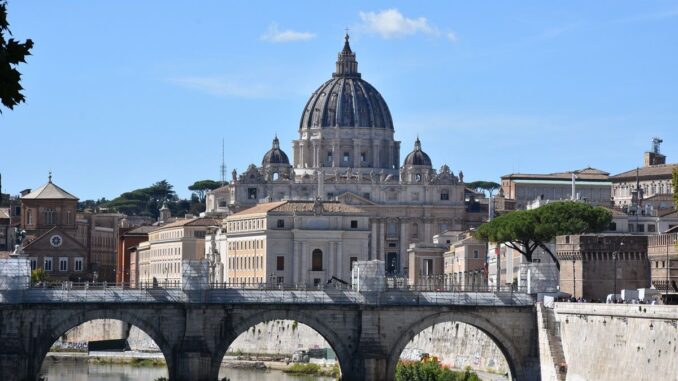
Photo of St. Peter’s Basilica and Tiber River in Rome by András Herter from Pexels


Be the first to comment