

At 4:15 on the morning of British Watchmakers’ Day, long before Westminster had properly stirred, a visitor from Austin, Texas quietly took his place outside Lindley Hall.
The square was still dark at that hour; the city paused in that brief interval between night and the first movements of the day. Yet there he stood with a watch roll in his pocket and a plan that had required a considerable journey and an even earlier alarm clock. He had come for one of the special editions.
British Watchmakers’ Day has developed a reputation for them in remarkably little time. The event has only existed for three years, after all, yet the now-traditional centrepiece is the limited editions that the show asks brands to create exclusively for the event. Some watch brands choose to make up to 50 of them available, others just a handful. Either way, they present a once in a lifetime opportunity for dedicated collectors.
By the time the first grey light appeared over Westminster, the man from Austin was no longer alone. A handful of other early arrivals had gathered, each of them sharing the particular mixture of patience and determination that characterises watch collectors when the prospect of a rare watch is involved. Conversations inevitably turned to watches almost immediately: where people had travelled from and which stands they intended to visit first as well as which limited editions were rumoured to be the most difficult to obtain. By the time the doors finally opened, the queue stretched a considerable distance down the pavement.
Inside Lindley Hall itself, the day unfolded slowly and deliberately across nine hours, during which nearly 50 British watch brands presented their creations beneath the vast glass ceiling of the Victorian exhibition hall. The venue itself proved ideal for the occasion. Natural light filtered through the roof and settled gently on rows of watches displayed across simple tables, creating an intimate atmosphere that felt far removed from the theatrical staging of larger international watch fairs.
There was something refreshingly direct about the entire arrangement. Collectors stood on one side of the table, the people who designed the watches or owned the company stood on the other, and the conversation began.
One of the early gatherings formed at the Fears stand, where the irrepressible Nicholas Bowman-Scargill spent much of the day discussing the company’s exquisite newest release with collectors who had followed the brand’s modern revival closely. Fears, originally founded in 1846, had become one of the most recognisable names in the contemporary British watch scene, combining historical references with quietly refined modern design.
The brand’s British Watchmakers’ Day special edition drew particular attention. Inspired by Edwin Fear’s 19th century pocket watch, the Brunswick variant featured a sterling silver case and traditional Roman numerals.
Across the hall the stand of Christopher Ward remained consistently busy throughout the day. Over the past decade Christopher Ward had transformed itself from a direct-to-consumer experiment into one of the most technically ambitious watch brands in Britain. Conversations around the table often drifted beyond aesthetics into engineering, finishing techniques and the gradual process of building technical credibility in a field long dominated by Swiss manufacturers. In essence, Christopher Ward is no longer a microbrand.
Nearby, Farer provided a welcome contrast to the more restrained designs elsewhere in the hall. Farer has built a reputation for colour and typography used with unusual confidence and its watches stood out immediately against the more conventional palette of many other pieces. But one of the standouts in terms of colour was the Apiar Gen 1.1 Underground, featuring a dial inspired by Maxwell Roberts’ 2024 circular London Underground map. Only three pieces were produced, priced at £3,000 each, featuring hand-filled enamel underground lines, a titanium case and a 68-hour power reserve.
Tucked into a corner, Bremont represented a different side of the modern British industry. Bremont’s watches had long drawn inspiration from aviation and engineering heritage and their presence served as a reminder that the resurgence of British watchmaking extends well beyond small independent studios. Without a doubt, Bremont was the biggest brand there, having recently launched a collaboration with Felix the Cat.
It’s the sort of playfulness we’ve come to regularly expect from Studio Underdog, which has designed watch dials inspired by watermelons and pizzas in the past. This year they did something different. There were no special editions, but instead a ‘watchmaking experience’ complete with a full-size watchmaking bench.
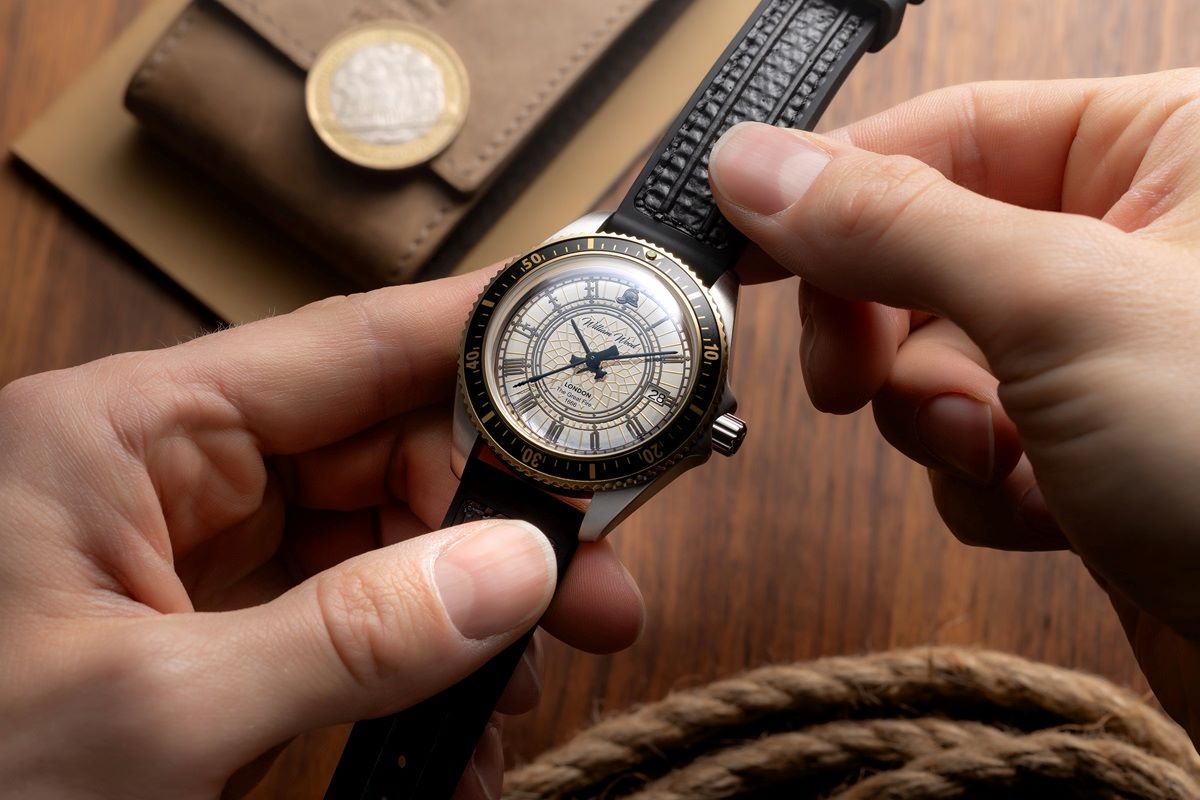
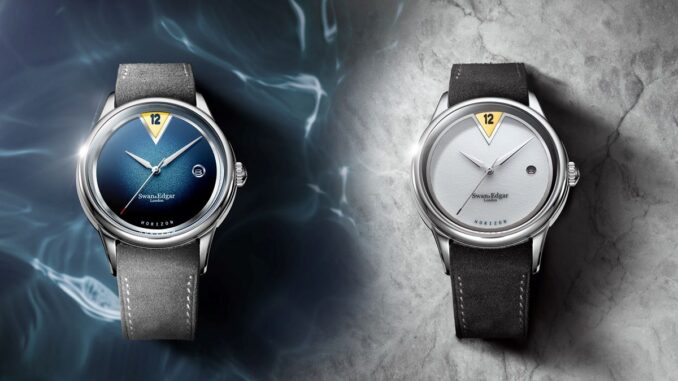
The variety within the room was perhaps the most striking aspect of the show. Within a few steps one could move from watches inspired by 18th century chronometers to chronographs whose design philosophy seemed rooted in pure creativity. Newer names such as Swan & Edgar hinted at a different trajectory altogether, where releases like the striking Horizon suggested a willingness to reinterpret British military identity through a more contemporary lens, without abandoning traditional craft. Yet the differences felt complementary rather than contradictory.
At the centre of British horology, both figuratively and literally at the event, stood Roger W. Smith. Smith, widely regarded as the modern torchbearer of traditional English watchmaking, had trained under George Daniels, whose invention of the co-axial escapement had reshaped mechanical watchmaking. Smith’s workshop on the Isle of Man produces watches in extremely small numbers, each one painstakingly crafted according to the exacting principles Daniels had championed.
His involvement in British Watchmakers’ Day carried symbolic significance. For many of the younger brands exhibiting in Lindley Hall, Smith represented proof that Britain remained capable of producing watchmaking at the very highest level of the craft.
Yet although busy, the event never felt frantic. The nine-hour schedule (split into three ticket allocations of three hours) allowed conversations to develop naturally and plenty of time and space to explore a wide variety of options.
Perhaps the most revealing discussions concerned the future of British watch production itself. For many years most British brands relied on Swiss manufacturing partners, a practical arrangement that allowed small companies to produce watches of high quality without constructing entire production infrastructures. Increasingly, however, there has been growing interest in bringing elements of production back to the United Kingdom. Several companies have already begun investing in local assembly, servicing and component manufacturing; Studio Underdog, for example, made headlines recently with its purchase of Maidenhead-based Horologium, a well-known watch assembler.
No one has suggested that Britain could replicate Switzerland’s centuries-old horological ecosystem overnight. But the ambition to rebuild elements of that tradition within this country is clearly gathering momentum.
By the evening, the atmosphere in Lindley Hall had grown noticeably calmer. Some limited editions had sold out entirely. Others remained quietly displayed beneath glass cases as collectors took the opportunity for one last look (or purchase) before the day concluded.
The visitor from Austin, who had arrived in darkness many hours earlier, eventually secured the watch he had travelled for (the Christopher Ward limited edition Loco). And another visitor came away with more than 10 of the limited editions for sale.
As the final conversations drew to a close and the hall gradually emptied beneath its glass roof, British Watchmakers’ Day once again left behind a subtle but unmistakable impression. Until quite recently, the notion of a modern British watch industry had seemed improbable.
After nine hours in Lindley Hall, surrounded by ambitious brands, curious collectors and a community that had grown steadily year after year, that notion felt considerably less improbable than it once had. To the where rumours suggesting that British Watchmakers’ Day will run across the whole weekend next year.
The die-hard collectors won’t care though. You’ll still find them arriving in the dead of the night long before opening hours, fixated on securing the very first of those prized limited editions.
Author Bio:
Anthony Peacock works as a journalist and is the owner of an international communications agency, all of which has helped take him to more than 80 countries across the world.

Be the first to comment