

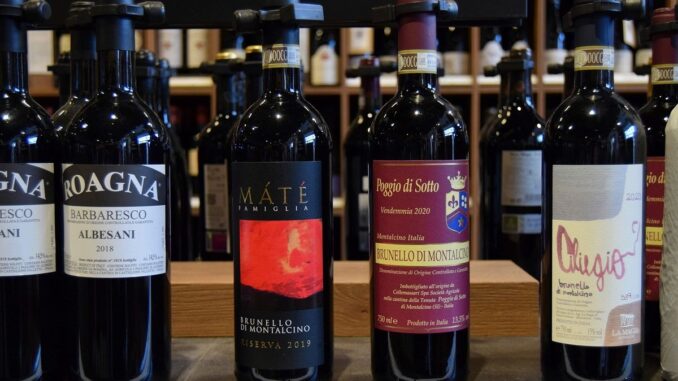
Last month I attended a pre-release tasting for the new 2021 vintage of Brunello di Montalcino, handpicked and hosted by Berry Bros. & Rudd in the Napoleon Cellars at their St James’s Street premises. It was also a great opportunity to chat with the producers and learn more about their estates and wine making process.
Sitting somewhere between 2016 and 2019 in style, this much awaited 2021 vintage offers more power than the graceful wines of 2019 and a greater immediacy than the exceptionally long-lived 2016s. What makes this particular vintage stand out though, is that the quality is consistently high right across the board, making this latest Tuscan release rather outstanding with wines that shine with purity of fruit, tension and effortless elegance.
Much like 2019, temperatures were generally higher than average during the year, with slightly less rainfall. However, this was not the case everywhere, as La Màgia’s high altitude vineyards had a very wet and cold end to 2020, setting them up for a superb 2021 while vital rain arrived in other parts of the region towards the start of spring, later than expected.
February and March saw temperatures pick up causing early bud break but were then hit by a severe frost in early April meaning that yields were reduced right across the region.
Parts of southerly Castelnuovo dell’Abate were badly affected, with Tassi losing 50% of their fruit from the Vigneto Tassi parcel. At Poggio di Sotto, low-lying plots near the river were also particularly badly hit with a loss of around 20%. Neighbouring Molino di Sant’Antimo was affected by the frosts.
Fortunately, the summer was warm and not too dry which meant that the vines were able to establish strong canopies for protection. High temperatures lasted until mid-August but without prolonged heat spikes. Temperatures exceeding the highs of both 2016 and 2019 were a contributing factor to the eventual powerful style of the 2021 vintage.
There was not a lot of rainfall during the growing season, giving the vintage its concentration. But the little rain that did fall gave the 2021 wine lift and remarkable balance. Some welcome cool rain towards the end of August refreshed the vines, helping to maintain acidity ahead of the all-important hang time prior to harvest. September conditions ended up being ideal, with warm days and cooler nights allowing for the development of phenolic complexity, which resolved tannins and juicy fruit structures. All in all, it was a very good harvest that didn’t finish until well into October.
Wine structure
Aromatically, the 2021 wines are classical. Think red and black cherry, blood orange, rose, violet and wild herbs and all with an earthy depth, much like classical vintages of the past. They are tannic and have a sculpted, architectural feel rather than raw power, making for wines that are juicy and inviting.
Wine producers
Despite the quality of the wines being exceptionally high, 2021 was an extremely challenging year for the producers. For example, the team at Máté started to prune later, pushing back budbreak and building a natural defence against frosts. In addition, they have started to train the vines around the trellising wires, reducing vigour which allow the vines to focus efforts on ripening and creating better canopies to withstand warmer and drier years.
La Serena
Andrea Mantengoli at La Serena is normally unphased by the challenges of warm and dry years, knowing that his vines are well equipped to deal with anything the growing season may throw at them. More recently he purchased a new, high-altitude plot at the top of the appellation which safeguards his vines with its cooler temperatures and brought three wines for us to taste that included a 2019 Brunello di Montalcino Riserva Gemini, 2021 Brunello di Montalcino and 2022 Rosso di Montalcino.
Scopetone
Scopetone fared better as they did not experience the challenges that other producers faced. Located outside the ancient walls of Montalcino, looking up towards the Fortezza, they had no frosts, no hail or particularly high temperatures during the growing season. We were able to sample a 2021 Brunello di Montalcino and 2023 Rosso di Montalcino.
Lisini
Lisini dates back to the time of the Medicis and is one of Montalcino’s oldest estates and few producers in Sant’Angelo in Colle and is also a founding member of the Corsorzio del Vino Brunello di Montalcino. Its proximity to Maremma and maritime breezes protects the vines from the summer heat. The soils of the 25 hectares vineyard are complex with fossil laced sand, clay and iron rich. This along with altitudes of 300 to 400 metres gives Lisini’s wines their unique personality. We got the opportunity to try five of their wines which included a 2020 Brunello di Motnalcino Ugolaia, a 2020 Brunello di Montalcino, Riserva, a 2021 Brunello di Montalcino, 2021 Brunello di Montalcino ‘Poggio Severo’ and a 2023 Rosso di Montalcino.
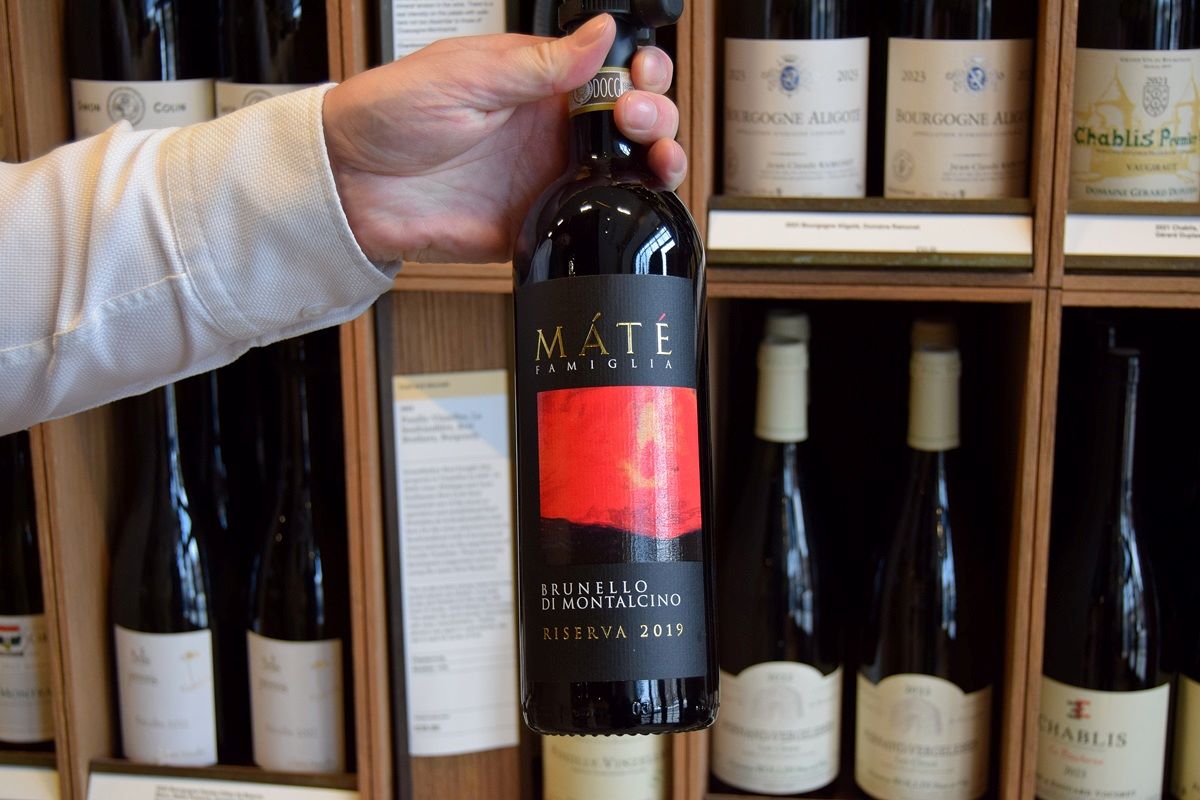
Máté
Once a Roman vineyard 2,000 years ago, the Máté family wine estate of seven hectares is located on two private hills on the sea-breeze side of Montalcino.
The grapes include Sangiovese in fossil-filled tufo, Merlot in sandy clay, Cabernet Sauvignon in marl and Syrah in the mineral-rich southern terraces like Cote Roti. They are hand-picked at full maturity and fermented in small temperature controlled stainless steel vats or new wooden barrels and aged for up to 2½ years in Allier French oak barriques and tonneaux. We got to taste a 2020 Brunello di Montalcino, Riserva, a 2021 Brunello di Montalcino and 2021 Máté Brunello di Montalcino, Veltha.
Poggio di Sotto
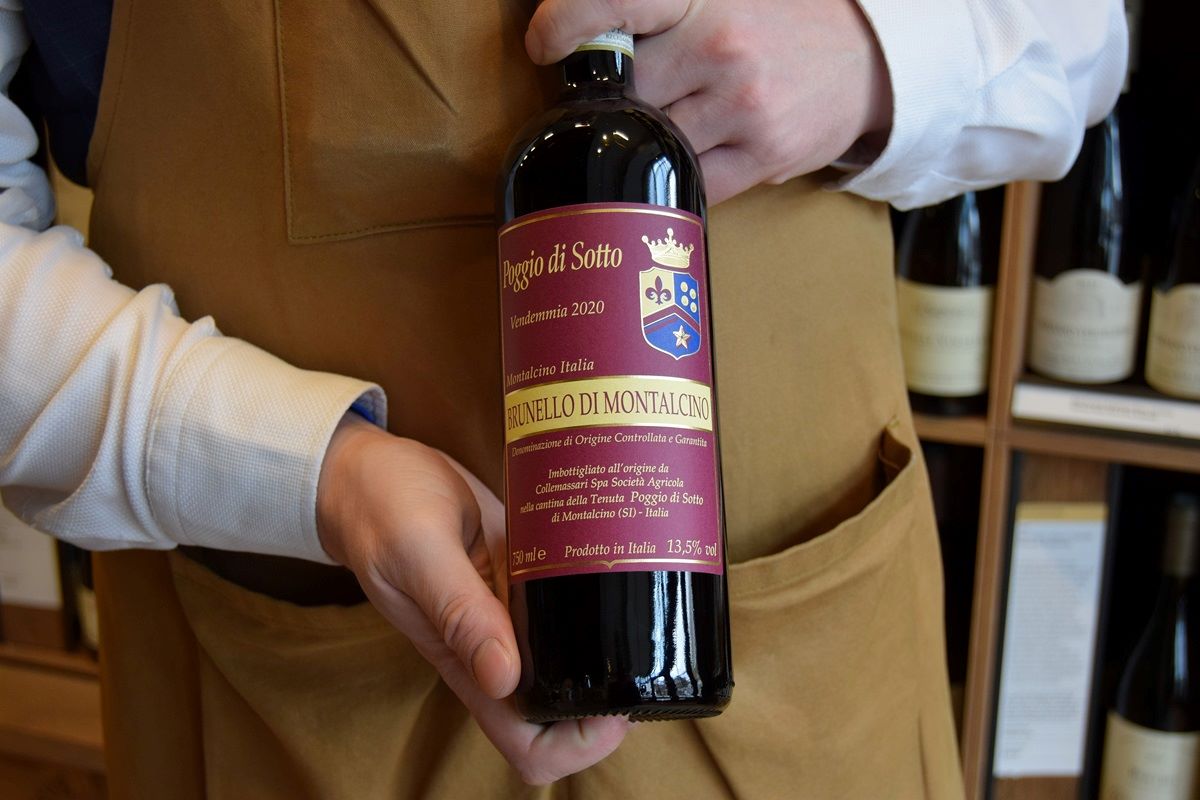
Poggio di Sotto was founded in 1989 by Tuscan Piero Palmucci and produces some of the most refined and sought-after wines in the region. It became part of the Collemassari Wine Estates back in 2011 and their 10 hectares of vineyards are all planted with low-yielding Sangiovese Grosso clones in the sunny Castelnuovo del Abate region on the south east side of Montalcino, situated at three different levels between 250 and 400 metres. We sampled their 2020 Brunello di Montalcino Riserva, 2021 Brunello di Montalcino and 2023 Rosso di Montalcino.
Tassi
With deep roots in Montalcino, the Tassi family have a long history of working the vineyards of Biondi Santi. They then became beekeepers for a while before going back to producing wine. Fabio Tassi, who owns the vineyard, is also a restaurateur, running the town’s Drogheria Franci restaurant. In addition, he also owns its most prolific wine shop. With an extremely good understanding of Brunello’s wines, vintages and vineyards, he has good relationships with many of the great winemaking families of Italy. Tassi brought three wines for us to taste that included a 2020 Brunello di Montalcino, Franci, Riserva, a 2021 Rosso di Montalcino and a 2021 Brunello di Montalcino, Giuseppe Tassi.
La Màgia
La Màgia has been owned by the Schwarz family since the mid-1970s and were among the first Brunello producers to estate-bottle their wines. It is an organic estate farmed by second-generation Fabian who was born in Montalcino and succeeded his father in 2005. We got to taste a 2020 Brunello di Montalcino, Riserva, a 2021 Brunello di Montalcino, 2021 Brunello di Montalcino Ciliegio and a 2024 Rosso di Montalcino.
Molino di Sant’Antimo
At Molino di Sant’Antimo, Valeria’s technical approach has taken the winery from strength to strength, performing a chemical analysis of the fruit every two to three days to accurately follow the season. She brought three wines for us to taste, that included a 2019 Brunello di Montalcino, Riserva, a 2021 Brunello di Montalcino and 2023 Rosso di Montalcino.
Conti Costanti
Possibly one of the finest estates in Montalcino is Costanti, producing extremely high-quality Brunellos that are elegant, complex and extremely long-lived. Their seven hectares of vineyards are situated in Colle al Matrieche in the eastern zone of the Montalcino district, 400 metres above sea level. The Brunellos tend to be amongst the richest and most harmonious wines in the district with abundant amounts of dark cherry and blackberry fruit, bolstered by slender and elegant tannins. We were able to taste a 2020 Brunello di Montalcino, Riserva and 2021 Brunello di Montalcino.
Pieve Santa Restituta
With 40 hectares of historic vineyards in the south-west of the Brunello di Montalcino DOCG, the Pieve Santa Restituta has stony and chalky soils, poor in nutrients but ideal for cultivating vines and in particular the Sangiovese variety. An additional 25 hectares were acquired in 2006 in the north-east of the denomination.
Pieve de Santa Restituta makes its Brunello di Montalcinos using the grapes from various parcels and two Crus, Sugarille and Rennina and brought three wines for us to try including a 2021 Brunello di Montalcino, 2021 Brunello di Montalcino, Rennina and 2021 Brunello di Montalcino, Sugarille.
Casanova di Neri
Perhaps one the of the most celebrated producers in Montalcino, Casanova di Neri is known for its world-class Brunello di Montalcino and was founded in 1971 by Giovanni Neri. Tenuta Nuova is very much their flagship wine and a benchmark for modern Brunello with a perfect balance of fruit, structure and complexity and we got to try a 2021 Brunello di Montalcino, Tenuta Nuova and 2021 Brunello di Montalcino, Giovanni Neri.
Ciacci
The Ciacci Piccolomini d’Aragona estate is located on the south east slope of Montalcino, close to the medieval village of Castelnuovo dell’Abate and the estate’s roots can be traced back to the 17th century.
Countess Elda Ciacci, who died in 1985 without any heirs, left the property to her long standing and well-respected estate manager Giuseppe Bianchini, who’s son and daughter, Paolo and Lucia, have developed the property and wines to their current respected position. The estate’s 220 hectares of the rolling Tuscan hills run alongside the Orcia River which helps to moderate the temperature of this hot and dry part of the region. 53 hectares are for growing the Sangiovese Grosso grape which produce the Brunello di Montalcino together with small amounts of Merlot and Cabernet Sauvignon. We tasted a 2021 Brunello di Montalcino and 2021 Brunello di Montalcino, Pianrosso.
Il Poggione
Founded in the late 19th century, Tenuta Il Poggione is a benchmark estate. The wines they produce are both intense and full-bodied, richly layered with dark fruit, menthol, sweet smoke, cocoa and spice. We enjoyed a 2020 Brunello di Montalcino, Riserva, Vigna Paganelli and 2021 Brunello di Montalcino.
Despite the challenging weather conditions and much smaller harvest, the 2021 Brunello di Montalcino wines are an excellent vintage and will be much sought after.
For more information on Berry Bros. and Rudd and their Brunello di Montalcino selection, please visit: www.bbr.com.
Author Bio:
Simon Burrell is a UK-based travel and motoring journalist and editor, a former member of The British Guild of Travel Writers and professional photographer.
Photographs by Simon Burrell

1 Trackback / Pingback