
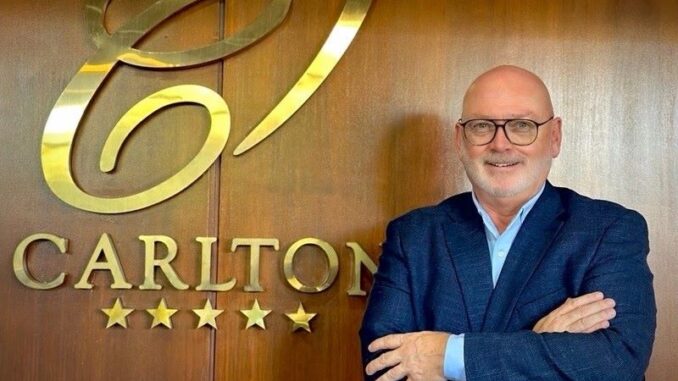
In our continuing series of hotelier interviews, I recently spoke with Hein Broekhoven, who is General Manager of the five-star Hotel Carlton Madagascar to ask what inspired him to follow a career in hospitality and hotel management given his 40+ years extensive experience leading luxury hotels across 13+ countries around the world.
Hein has stabilised, repositioned and optimised hospitality assets in complex and high-pressure environments as well as having been responsible for the pre-opening of boutique resorts and dealing with ownership changes, brand conversions and property renovations. This has meant partnering closely with owners, architects and development teams to translate design concepts into operationally efficient and guest-centric environments.
Speaking English, French, Dutch and German have helped Hein work with building high-performing multicultural teams and anticipate operational challenges and service in luxury high profile properties and multinational hotel groups, such as Marriott, the Colony Club in Barbados and hotels in Haiti, Morocco, Switzerland, Algeria and now Madagascar.
What inspired you to pursue a career in hotel management, and was it something you wanted to do from an early age?
“I was born in Goirle, in the south of the Netherlands, in 1963, the oldest of four, into a family that had been in textiles for three generations. That was never going to be me. We travelled as a family when I was young, and I’d caught something from it.
“The person who pointed me in the right direction was my grandfather. He’d sailed with the Holland America Line, and he told me there was only one business that would take me anywhere in the world: hospitality. Any time, any situation, hotels and restaurants are always working. That was the whole argument, and it was enough.
“So no, it wasn’t a childhood ambition to run hotels. I wanted to see the world, and this was the trade that would pay for it rather than the other way round, which is a very Dutch way to think about it.
“We moved to Belgium and I did most of my schooling there. I started with two years of commerce at junior business school in Tongeren before switching. My father was living in Brussels, and he was clear about it: if you want hospitality, go to Brussels, it’s a bilingual city, and in the 1980s French was still one of the base languages of the industry. So, I went to COOVI and studied in Dutch and French. My French at that point was maybe twenty percent. I had to learn it as I went. I graduated in 1984 and started as a waiter at ‘t Scholteshof in Hasselt that June.”
Over 40 years and more than 13 countries, is there a place you most enjoyed living and working in?
“Switzerland, without hesitation. Montagne Alternative sat at 1,500 metres above Orsières, in Commèire, a hamlet of eight inhabitants. 28 rooms, 12 associates and a product entirely of its own, small, private, secluded, high-end and genuinely sustainable. It became Switzerland’s first hospitality B Corp in 2014. Everything about it was embedded in the local culture and in two clear seasons, summer and winter, and with a small, dedicated team we could deliver something luxurious and completely of its place.
“What stayed with me is what it did to people. The higher you go into those mountains, the more solitude you find, and guests come back to their own surface, their own soul. It gave them more than they expected. It did the same for me.”
Does any particular property stand out?
“Port-au-Prince. Not because it was the most beautiful property I’ve run, it wasn’t, but because it asked most of me. I arrived at a 155-room five-star hotel in a country where the security situation could change between breakfast and lunch, and then COVID arrived at the top of it. We repositioned the hotel entirely, from a leisure property to a business long-stay model with junior apartments, because the leisure market simply no longer existed. We kept all 155 associates employed through the whole period. We recorded zero security incidents, working closely with local authorities and the US Embassy. When you get a team through something like that intact, the bond is different from anything you build in easier places.”
What have been the biggest challenges in managing a hotel and its staff since COVID?
“I spent the pandemic in Haiti, which was an unusual vantage point. The immediate challenge was keeping people employed and keeping morale up when there was no business.
“Since then, the harder problem has been with people. The industry lost a generation of experienced staff during those years, and they did not all come back. At Fès I inherited a historically independent 240-room property that needed realigning to Marriott standards with 180 associates, many of whom had never worked to a brand critical path. That’s not a systems problem; it’s a training and confidence problem. We got guest complaints down by more than 30%, but it took retraining, clear SOPs and empowering the front line to fix things on the spot rather than escalate.”
Face-to-face contact and the personal human touch play a crucial role in the guest experience. Do you think technology will replace some of that interaction?
“Face-to-face contact will always be crucial, and technology will not change that. What it does is make it easier – it lets you check who you are talking to and arrive at the better prepared conversation. But the connection itself, the personal feeling you bring across, that fills the gaps no information system can. That part stays human.”
Where do you see AI playing a role in hospitality, in the short and long term?
“Yes, AI will play a real role. It picks up the speed of the offering, it lets marketing and sales work together in one system, and it gives you a faster, clearer view of the finances. With the right tools you get an analysis and a proper presentation in minutes instead of days. Time is of the essence in this business.
“But never forget that time is still managed by people. The cost may be better, the writing may be better, the translation may be better, but it is still a person who puts in their own soul, their motivation, their personality. A machine will not replace that.”
How would you define your management style?
“Hands-on and visible. I’m on the floor. If I’m sitting in my office all day, I’m not doing the job, I’m doing paperwork about the job. I lead by example because staff read what you do far more accurately than what you say in a briefing.
“Beyond that: work smarter, not harder. I’d rather redesign a process than ask fifteen people to work longer. And I train. In pre-opening especially, you’re building a team from nothing, sometimes 120 people in a market where nobody has worked to international standards before. Coaching isn’t a side activity in that situation; it’s the entire job.”
What’s the most challenging part of being a General Manager?
“Standing in the middle. A General Manager answers to owners who want returns, a brand that wants compliance, guests who want to feel like the only people in the building, and a team who want to be treated decently. Those four things pull in different directions almost daily and nobody else in the hotel has to reconcile all of them.
“The other part is that it’s a lonely seat. You can be surrounded by 180 people and still be the only person who can make a particular call.”
What advice would you give someone starting out, and what path would you recommend to General Manager?
“Learn operations from the floor up, and don’t skip F&B. It’s the hardest department to run, and if you can run it, you can run anything. Learn languages, I work in four, and it has opened doors that a CV alone would not have.
“And take the difficult postings. The comfortable job in a stable market will teach you less in five years than one pre-opening in a complicated country teaches you in one. Every real jump in my career came from saying yes to something that looked like a headache: Algeria, Haiti, a lodge at 1,500 meters in a village of eight people. Pre-openings in particular are the fastest education available because you touch every department at once!
Looking back, is there anything you would have done differently, and what are your goals for the future?
“Looking back, I left the industry twice and came back both times. I think that tells you what I needed to know.
“As for the future, I still like doing what I do. I’m fully mobile, which makes me a useful candidate for the work I enjoy most, pre-opening projects, but equally conversions and the revitalisation of existing operations. But whatever results I book, I only book them through the teams I work with. They have to be empowered, motivated and trained in what I believe are the key factors of good hospitality: empathy, respect, dignity and equality. Keep your eyes and ears open for what the guest wants and always treat them with respect.”
What do you do to relax and switch off?
“Cooking, mostly, and eating locally wherever I am, food is still the fastest way into a country. Hiking, always. And I’m a film fanatic; films and documentaries give me peace and quiet, and a lot of creativity comes out of that.
“But the real pleasure is visiting other operations and colleagues, quality places and sometimes the simplest, most remote local spots. That’s where I find the quiet. And a proper night’s sleep, which is the real trick.”
Are there other cities, countries or continents you’d like to work in?
“The Caribbean has been in my blood since I was young, and South America follows naturally from it, the supply lines into the Caribbean run through there, so it’s a logical extension. Canada I genuinely love; there’s family there, and it offers a multicultural, multilingual environment that I find very appealing. Africa I’ve done, several times over and I don’t feel the need to go back.
“What draws me now is Asia. Visiting the Peninsula in Hong Kong and the JW in Beijing showed me a level of product and service that has stayed with me, and a former area manager of mine has just moved to Vietnam and tells me it’s somewhere I’d thrive. The Indian Ocean interests me too, the Seychelles and properties of that kind.
“Let me be honest about age. At 63 you’re competing with people a decade younger – but forty years across a dozen countries is something they simply cannot bring to an operation yet. For an owner who actually wants that depth of experience, it’s an advantage rather than a drawback. What I look for now is an operation that is running properly and has the means to do the job well.”
For more information on the Hotel Carlton Madagascar please visit: www.carlton-madagascar.com.
Author Bio:
Simon Burrell is a UK-based travel and motoring journalist and editor, a former member of The British Guild of Travel Writers and professional photographer.
Photograph courtesy of Hein Broekhoven

Be the first to comment