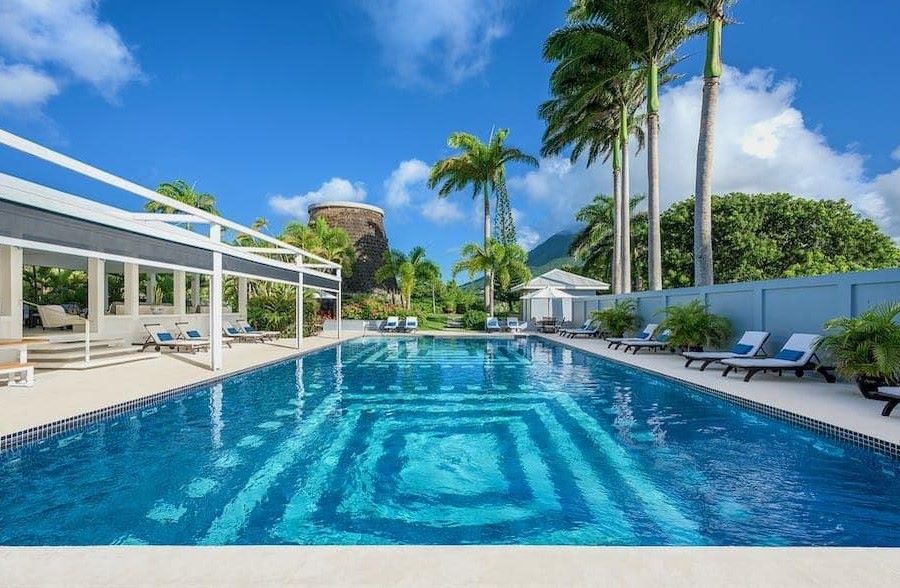
It is a strange feeling following in the flip-flop steps of royalty and swimming in the same palm-fringed pool in which Lady Diana displayed her breaststroke and Harry and William learned to “bomb” although those years ago.
Although I doubt the resident Labrador didn’t sink his teeth into their beach ball and puncture it as it did ours.
In 1992, HRH Diana, Princess of Wales stayed with the young princes at the exclusive Montpelier Nevis (formerly Montpelier Plantation Inn) on Nevis when her separation was announced. The “boutique” hotel has 18 rooms and villas and its own private beach, Pinney’s, 10 minutes away.
The estate goes back to 1687, and the inn has been run by the Hoffman family since 2002. It also boasts the Mill Privée private function room in a 300-year-old sugar mill.
The poolside Indigo may very well be where William and Harry developed their taste for molecular cocktails.
There are four other plantation inns on Nevis. The 10-acre Old Manor House offers rooms in a former hospital, forge and smokehouse and you can enjoy afternoon tea and the trade winds on the terrace.
The Nisbet Plantation Beach Club was famous for its 18th century Great House and avenue of palms going down to the sea. It is named after Fanny Hamilton nee Nelson’s first husband, Josiah.
The main house of Hermitage Nevis is the oldest wooden house on the island and perhaps the oldest wooden house in the Caribbean. The sitting room dates back to 1670.
Owner, Richie Lupinacci, whose family originally came from Pennsylvania, said:
“Our family discovered this old house in 1971, when it was little more than a ruin lost in the bush, when there were more people on the island riding donkeys than driving cars and the electricity went off every afternoon at 4 o’clock.
“It took us a little time to make the house habitable again, tame the jungle, install water and electricity and fill in the 1670 privy. In 1984, once we had finally perfected the rum punch recipe, we started charging our house guests!”
Watched closely by vervet monkeys as we sipped our “Killer Bees” (rum punches) our host extolled his adopted home, saying:
“Nevis is a small island and nowhere is far away. You can drive around the entire island in an hour. At 800 feet above sea level, we have the advantage of catching the cool trade winds that blow almost regularly out of the east. We have our own herd of cattle who help with the burgers. Our carrot cake is famous. It’s a quiet place despite the bell frogs and Cuban tree frogs. The hurricanes of 1989 and 1995 proved the soundness of this construction.”
The Hermitage is surrounded by mango trees brought from India in the early 1700s, breadfruit brought from Tahiti by the British to feed the slaves who rejected it when it was then used to feed pigs, night blooming cereus, royal palms, coconut trees and tamarinds as well as the Poinciana (or flamboyant tree), which is the national flower of Nevis and St Kitts, sister island to Nevis which is only a short ferry ride away.
Nevis is as friendly a Caribbean island as you can find. Columbus, who in 1493 called Nevis “Nuestra Senora de las Nieves” (Our Lady of the Snows) after its one cloud-capped peak, brought sugar plants to the New World from the Canary Islands. The discovery of tea in India made the Europeans suddenly so sweet-toothed. At one stage slaves outnumbered the English a thousand to one. St Kitts was the centre of the industry.
The 40-acre gardens were designed by Miami-based designer Raymond Jungles under the stewardship of New York artists Helen and Brice Marden, owners of Golden Rock. Helen curated the plant selection and Brice placed lava boulders that were unearthed during excavation. It has over fifty palms.
Native plants and grasses are found alongside exotic flowering trees and bushes like the pagoda flower and sausage tree. Golden Rock also boasts a collection of cycads.
During your stay you may well be serenaded by tree frogs and see green vervet monkeys, purple-throated caribs, Antillean crested hummingbirds and bananaquits.
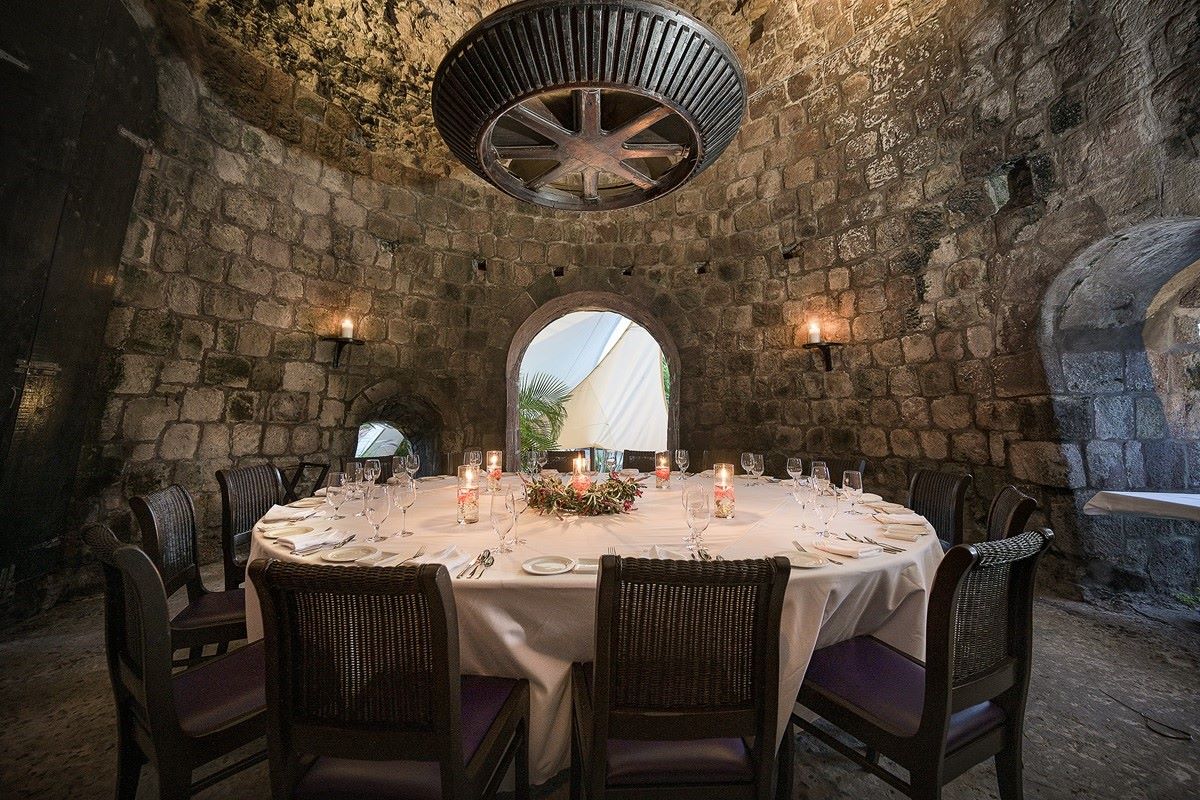
Reception is the old 1801 counting house where the hogsheads were counted and The Drip House is where they purified the water. You can even stay in their sugar mill suite.
The sugar industry ended mainly because of the size of Nevis and St Kitts. Neither could compete with or modernize at the same rate as other countries. And eventually young locals refused to work the fields because it was too hard and too hot. And bar work and water sports paid better. Sugar production officially ceased on the two islands in July 2005.
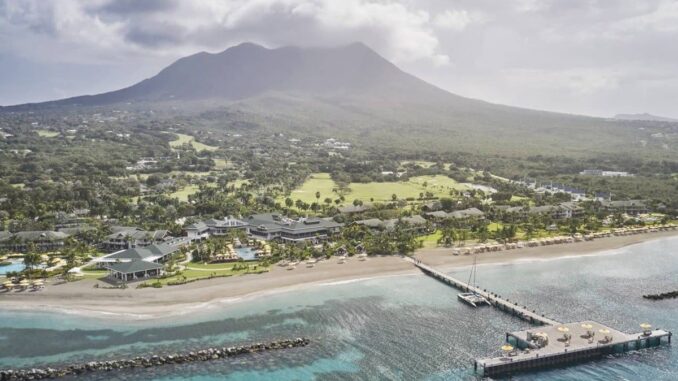
The island’s top luxury hotel is the beachfront Four Seasons Resort Nevis on Pinney’s Beach in Charlestown known for being family-friendly and its top-tier service.
If they are not talking about sugar the Nevisians talk about Horatio Nelson. He arrived as captain of HMS Boreas in 1785 and spent two years enforcing Britain’s Navigation Acts which were intended to keep her colonies trade exclusive to the mother country. He had a lookout at Saddle Hill. Nelson Spring provided his fresh water, and he attended a ball at the Bath Hotel, the first tourist hotel in the Caribbean.
Unsurprisingly, Nevis also has a Nelson Museum. One of the exhibits is a scrap of the Union Jack flag from HMS Victory.
On 11th March 1797, Nelson married Frances Fanny Herbert Nelson under the silk cotton tree, a short stroll from the Montpelier Plantation Inn. Fanny, a young widow, was the niece of the owner of the Montpelier sugar plantation. The future William IV gave the couple away. St John’s Fig Tree Church holds their wedding licence. Nelson left the island in 1798, and the couple separated in 1801.
As yet, there is no all-inclusive “Admiral Nelson Resort” or a Horatio honeymoon “hideaway” offering generous high season discounts to people with one eye and half an arm. However, a “Lady Di Suite” might be in the pipeline.
Author Bio:
Kevin Pilley is a former professional cricketer and chief staff writer of PUNCH magazine. His humour, travel, food and drink work appear worldwide, and he has been published in over 800 titles.
Photographs courtesy of Four Seasons Resort Nevis and Montpelier Nevis


Be the first to comment