

There’s nothing quite like the freedom of the open road, but a dead battery or a faulty headlight can bring your adventure to a screeching halt. Before you pack the snacks and finalise your playlist, spending a little time on a few simple vehicle electrical checks can save you from a major roadside headache.
Making sure your car’s electrical system is in top shape is just as important as checking the tyres and oil. Here’s a straightforward guide to the essential electrical checks you should perform before your next big trip. Keeping your vehicle in top condition goes beyond just the electrical systems; it involves comprehensive road trip preparation to prevent unexpected issues on the open road.
Start with the heart: your car battery
Your car’s battery is like its heart. If it fails, nothing else works. Start by giving the battery a good look. Do you see any corrosion, that white or bluish powdery stuff on the terminals? If so, you can clean it off with a wire brush. Also, make sure the cable connections are tight and don’t wiggle around. Making sure your vehicle is in top condition before hitting the road can prevent unexpected issues, so consider a pre-trip inspection to address any potential problems.
Most car batteries last about three to five years. If yours is getting old or your car has been slow to start, it might be time for a new one. Lots of auto parts stores will test your battery for free. If you’re not sure about its condition or you see the battery case swelling, it’s best to ask a professional.
For travellers getting ready for a trip to Australia’s Gold Coast, for example, a local auto electrician in Tweed Heads can easily diagnose any battery problems. It’s a small step that prevents a huge hassle later on. Knowing how to check your car battery’s age can also give you a clue as to whether it’s nearing the end of its life.
Let there be light: checking your headlights and taillights
Working lights are a must for safety, especially when you’re driving at night or in bad weather. This check is super simple and only takes a minute with a friend. Have someone stand outside the car while you try out every light function.
- Low beams and high beams
- Brake lights (don’t forget the third one)
- Turn signals (front and back)
- Hazard warning lights
- Reversing lights
And don’t forget the inside lights, like the dome light and dashboard lights. If a bulb is out, replacing it is usually an easy and cheap fix you can do yourself. If your headlights are dim or flickering it could mean a bigger electrical problem such as an issue with the alternator which charges the battery while the engine runs. Good lights are super important for both seeing the road and making sure other drivers see you.
Don’t forget the fuses and wiring
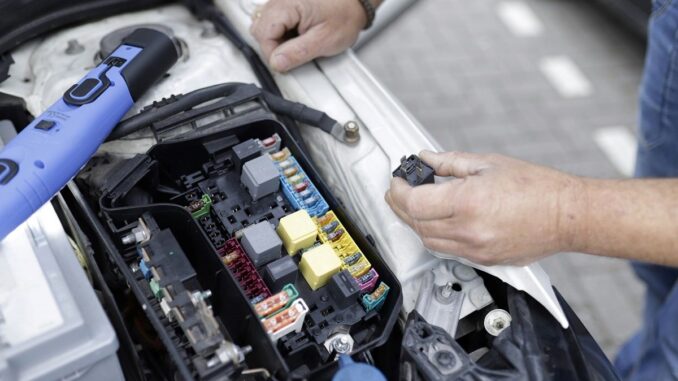
Your car’s fuses are there to protect its electrical parts from power surges. A blown fuse can cause anything from a dead radio to power windows that won’t move. Your owner’s manual will show you where the fuse boxes are (most cars have one under the bonnet and another inside the cabin). Take a quick peek to see if you can spot any obviously blown fuses which will usually have a broken wire inside. It’s a good idea to keep a kit of spare fuses in your car, just in case.
While you’re under the bonnet take a look at the wiring you can see. You don’t need to be a mechanic to spot trouble. Look for any wires that look cracked, frayed or chewed on by little critters. Damaged wiring can cause short circuits and make things unreliable, so catching it early is key.
Powering your gadgets: test your outlets and ports
These days a road trip often means a GPS, smartphones and maybe even a portable cooler. All these gadgets need power. Before you hit the road, test all your car’s 12V outlets (the old cigarette lighter ports) and any built-in USB ports.
Plug in your phone or a charger to make sure each one is working. Finding out that your only charging port is dead when your phone is at 5% and you’re in the middle of nowhere is something everyone wants to avoid. If a port isn’t working it’s often just a blown fuse, so check that first.
A portable power bank is also a great backup to have in your car. It ensures your essential devices stay charged no matter what.
These quick and easy checks take less than half an hour but can make all the difference between a smooth journey and a frustrating one. Once you’ve confirmed your car’s electrical system is ready to go, you can focus on the adventure ahead.
Photo by Maxim Hopman on Unsplash

3 Trackbacks / Pingbacks