
By the time you arrive in Geneva during Watches and Wonders week, the city already feels as though it has been awake for days.
For that one week every year Geneva becomes the centre of the horological universe, as Watches and Wonders has now evolved far beyond a conventional trade fair. Held inside the vast Palexpo complex near Geneva airport, the event has become the luxury watch industry’s equivalent of Fashion Week or Cannes: part business gathering, part cultural spectacle, part luxury theatre.
Around 60,000 visitors attended this year, with more than 65 brands exhibiting (a record) and Audemars Piguet among the major arrivals expanding the fair’s already enormous footprint.
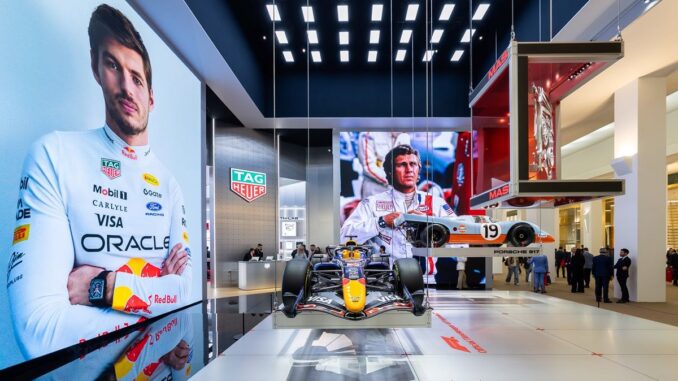
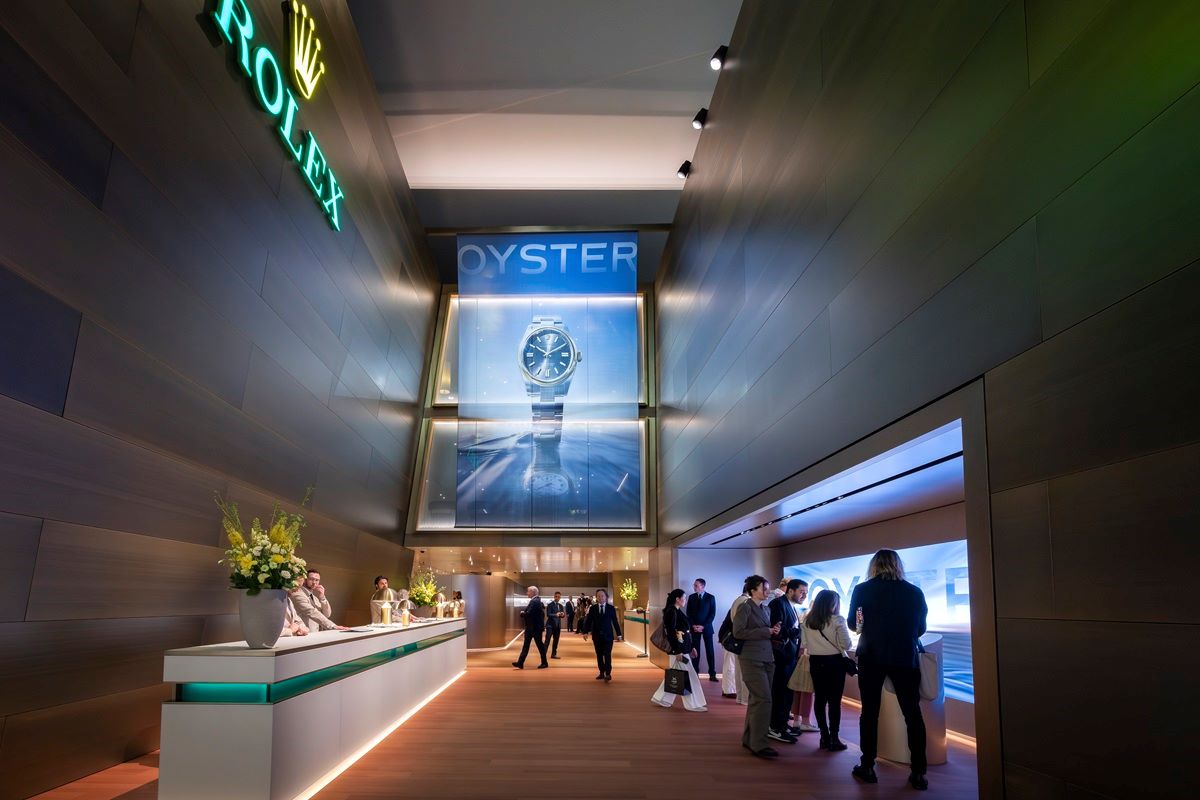
The sheer scale can feel faintly surreal when you first walk in. Rolex occupies a towering multi-level structure that resembles a futuristic embassy more than an exhibition stand. Cartier’s pavilion feels closer to an art installation. TAG Heuer, IWC, Jaeger-LeCoultre, Vacheron Constantin, Patek Philippe and dozens of other major names compete not just through watches, but through architecture, atmosphere and storytelling.
Everything is choreographed. Launches unfold with cinematic precision beneath carefully calibrated lighting. Giant LED walls flicker into life. Executives unveil watches as photographers surge forwards in unison. Even the queues become part of the spectacle. Outside Rolex, visitors fight for position to spend just a few minutes in front of the new watches.
But what has become increasingly fascinating is the contrast between appearance and reality. Because the industry often presents itself with extraordinary confidence, certainty and polish during Watches and Wonders. Yet beneath all the theatre often lies something much more human: uncertainty, surprise, disagreement, obsession and emotion. And nowhere is that contrast clearer than with the example of Rolex: the kings of Geneva. It’s no coincidence that the brand’s famous logo is in the form of a crown…
One of the oddest aspects of modern watch journalism is that opinions are often formed before anyone has physically seen the watches.
At midnight or in the very early hours of launch day, the top brands distribute their press releases and imagery. Journalists around the world rush to publish reactions immediately and articles are written within minutes. Conclusions are drawn almost instantly, with watches praised, criticised, ranked and dissected before they have even emerged from behind the glass.
Then, a few hours later, everyone heads into Watches and Wonders to discover what the watches actually look like. It’s slightly absurd if you think about it: a bit like writing a restaurant review before tasting the food.
And Rolex, more than any other brand, exists at the centre of this strange annual ritual mainly due to their insistence on top secrecy until the last minute.
When the drop finally comes, every new release is analysed with microscopic intensity. Tiny changes become headline news and dial colours are debated like political policy. Even bracelet refinements trigger thousands of comments online. Expectations grow so large around Rolex and Patek Philippe launches in particular that the watches themselves can almost struggle to exist independently from the noise surrounding them. And that’s why seeing the watches in person actually matters so much.
Photographs flatten watches and studio lighting removes context. Social media also amplifies extremes. A watch that appears subtle online can feel loud in reality. Yet something easily dismissed in photographs can suddenly become magnetic once it catches natural light on the wrist.
This year, Rolex perhaps demonstrated that more clearly than any other brand. Straight after arriving at Watches and Wonders, I headed directly towards the Rolex stand, just like most people. Initially this achieved very little.
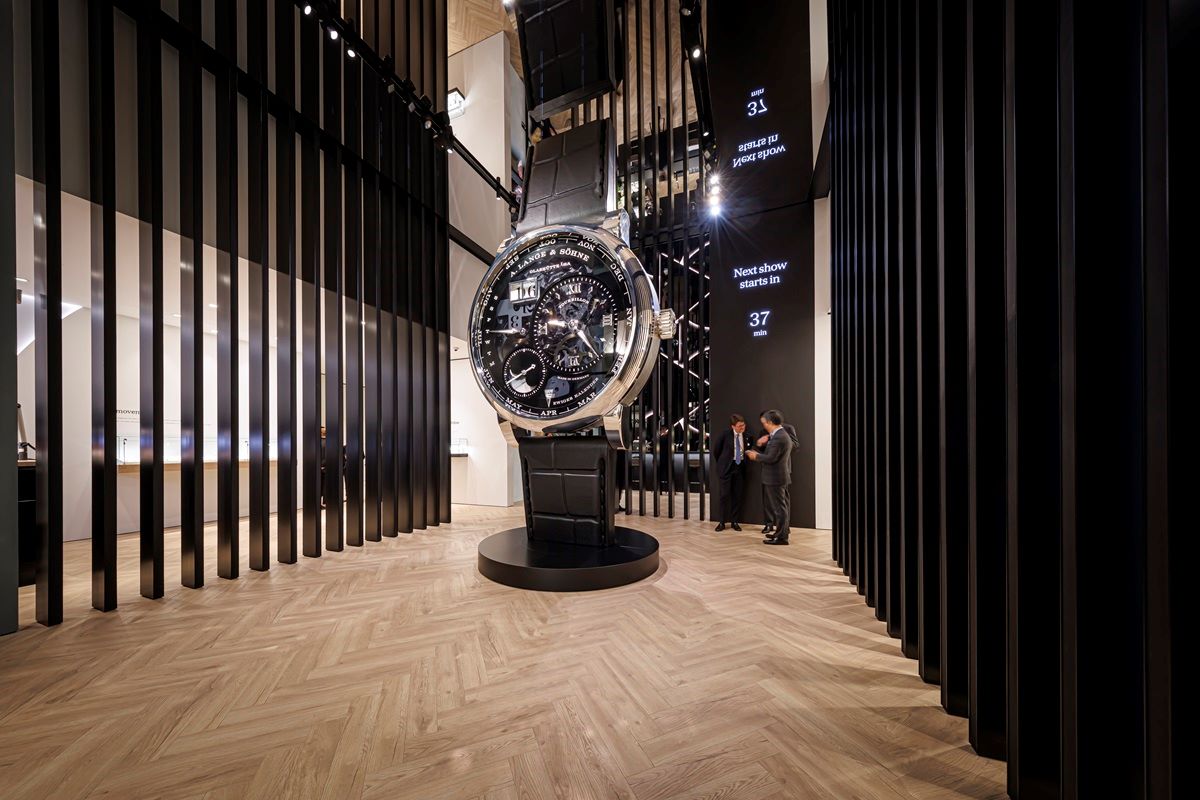
The crowd surrounding the displays resembled a horological feeding frenzy, with journalists and collectors packed shoulder-to-shoulder trying to photograph watches through layers of reflections and elbows. But eventually the crowd thinned enough to properly see the collection.
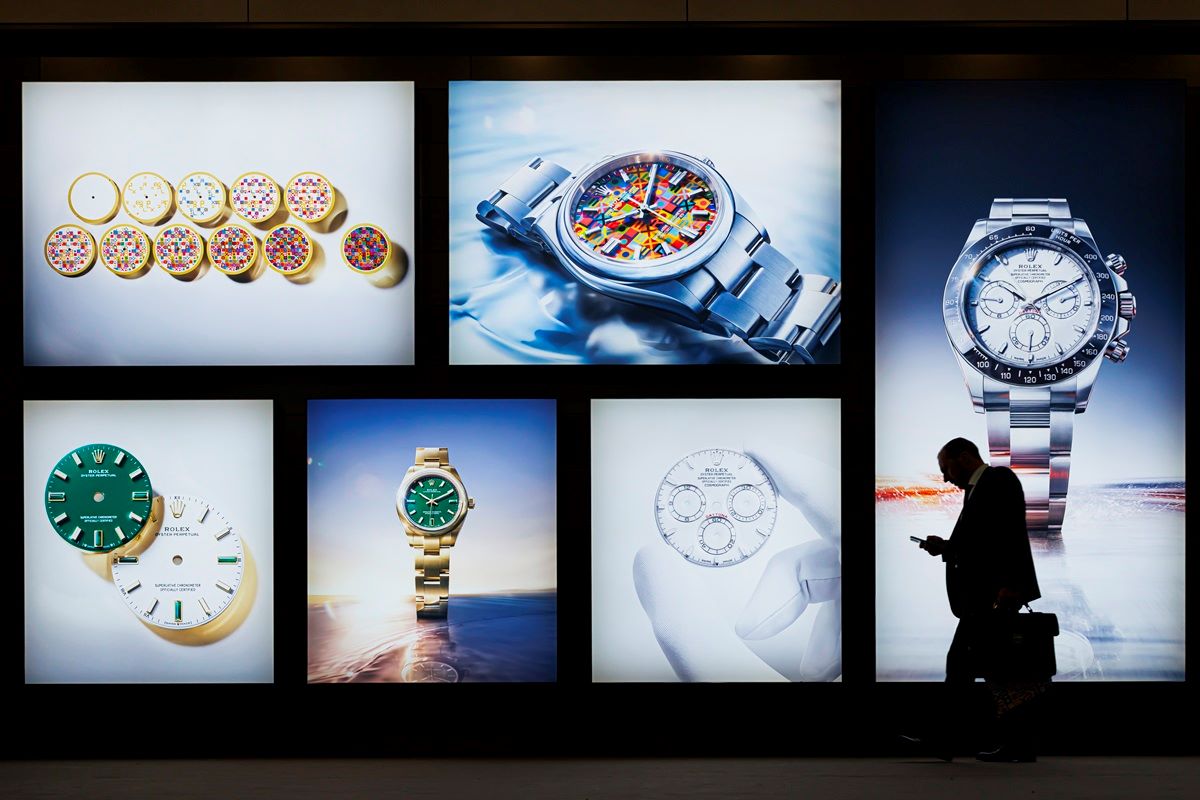
And immediately several of the assumptions created by the press photography started to shift. The new two-tone Oyster Perpetual celebrating the centenary looked excellent in person. The grey dial possessed more texture and warmth than expected, although the green Rolex script proved harder to read against the background than the imagery initially suggested.
More interesting was the new ‘Jubilee Gold’ alloy appearing in the Day Date.
From the official photographs it seemed as though Rolex was pursuing something softer and more understated: a warmer, more muted interpretation of gold that blended elements of yellow, white and Everose into something more restrained.
In reality, under the bright lighting of the stand, it felt considerably more extroverted.
The moss-green dial paired with Jubilee Gold delivered far more shine and presence than expected. The smaller Oyster Perpetual 28 in gold with the green dial created a similar impression. Perhaps that was partly the effect of the exhibition lighting or maybe green dials simply amplify visual drama more than photographs suggest?
Interestingly, the new Datejust with its graduated dark green dial worked far better in person, at least for my taste. The fading outer edges were significantly darker than they appeared online; almost black in certain lighting conditions, which gave the dial greater depth and legibility. It felt sophisticated rather than attention-seeking.
Then there was the colourful Oyster 36 Jubilee. In press shots it already seemed loud.
In reality it looked almost explosively bright. The multicolour dial radiated across the room with the sort of visual confidence that made restraint feel entirely irrelevant. This is absolutely not a watch for anyone hoping to avoid attention while walking through central London at night. But perhaps that’s exactly why it works.
The best releases often provoke division, after all. Some people immediately adored the kaleidoscopic dial while others hated it – and usually, that tension is a sign that a brand has created something memorable rather than merely safe.
Then there was the latest Rolex Daytona. If there was one watch that perfectly illustrated the difference between expectation and reality at Watches and Wonders 2026, it was this one.
On paper, it didn’t seem revolutionary. The Daytona is already such a deeply established icon that major changes always feel unlikely. The expectation heading into Geneva was essentially to see another careful refinement of a familiar formula.
Instead, Rolex quietly produced one of the strongest watches of the entire week.
For me, the enamel dial changes everything. What could easily have become flashy or overly decorative instead felt warm, rich and surprisingly balanced in person. Enamel is traditionally associated more with dress watches than sports chronographs, yet somehow it worked beautifully within the Daytona’s architecture; the dial gaining depth without losing clarity. Light moved across the surface differently from lacquer or metallic finishes, giving the watch a softer, more organic character that absolutely complemented the complexity of the case and sub-dial layout. And crucially, perhaps counterintuitively, it didn’t feel ostentatious in the slightest. It just felt epic.
That balance is perhaps Rolex’s greatest strength when it gets things right. The brand rarely chases radical experimentation for its own sake. Instead, it focuses obsessively on proportion, cohesion and refinement.
The Daytona already possessed one of the most balanced and emblematic designs in modern watchmaking. This latest version somehow sharpened that balance even further.
There was no major anniversary attached to the Daytona this year, not any grand narrative. Yet quietly, almost accidentally, Rolex may have produced the watch that generated the strongest emotional reaction all week. For me at least.
For several years, the luxury watch industry has operated inside a climate dominated by hype, scarcity and increasingly aggressive luxury positioning.
Waiting lists became status symbols, as social media amplified the idea that certain watches mattered not because of their design or engineering, but because other people couldn’t obtain them.
Yet Watches and Wonders 2026 felt subtly different. There was a sense across Geneva that the industry may be recalibrating. Many of the strongest releases were not the loudest or most complicated. Instead, the fair felt more dominated by restraint.
Smaller case sizes appeared everywhere. Elegant 38mm and 39mm proportions increasingly replaced the oversized sports-watch mentality that has defined much of the previous decade. Vintage inspiration remained hugely influential but brands seemed more interested in reinterpretation than direct nostalgia, with textured dials, softer colours, brushed metallic surfaces, and less obvious luxury. Even among the biggest brands there was a growing awareness that collectors are becoming perhaps more nuanced in what they want.
Patek Philippe made much of the 50th anniversary of the Nautilus, naturally attracting huge attention, while Cartier arguably delivered some of the most elegant pieces of the entire show with the sculptural Crash Skeleton and a continued exploration of that rarefied space between jewellery and watchmaking.
TAG Heuer’s Monaco Evergraph pushed their motorsport icon in a more futuristic direction while maintaining the look of the original, while IWC unveiled technical pieces inspired by space exploration, including the almost sci-fi-like Big Pilot Ceralume.
Yet the watches people continued talking about were often the ones with the clearest identities rather than the most obvious prestige. And increasingly, some of those conversations were happening outside Watches and Wonders entirely.
The modern Geneva watch week no longer revolves around a single exhibition.
Around the official fair, an entire ecosystem of satellite events, independent showcases, collector gatherings and temporary exhibitions has emerged. Increasingly, some of the most exciting energy exists beyond the polished walls of Palexpo.
Time to Watches perhaps captures this shift most clearly. Held in Villa Sarrasin, right next door to the main Palexpo exhibition complex, it offers something deliberately different from the grandeur of Watches and Wonders. The atmosphere feels more conversational, more relaxed and considerably less corporate. The same can be said for Chronopolis in the city centre which showcases some even more maverick brands.
At both these smaller shows, founders stand beside their watches discussing inspirations, frustrations, movement suppliers and design decisions directly with collectors. There’s a lot less choreography and more spontaneity.
The British presence felt particularly strong this year. Studio Underdog drew crowds constantly, proving that humour and personality still have a place within an industry that often takes itself extremely seriously.
Dennison also attracted attention with its unapologetically seventies-inspired aesthetic and elegant cushion cases. Fears highlighted understatement with beautifully restrained designs that almost felt radical in their quietness.
What united many of these British brands was not a shared aesthetic but a shared willingness to embrace individuality. British watchmaking currently feels broad, emotionally driven and experimental in ways that contrast sharply with the rigid hierarchies often associated with Swiss luxury.
Walking through Geneva late at night after the exhibition halls had closed, you could still feel the industry – from all over the world – vibrating around the city.
Collectors compared wrist shots beneath streetlights. Journalists hurried from corporate dinner to corporate dinner (as a journalist invited to the show, you don’t put your hand in your pocket all week such is the overwhelming extent of the hospitality).
Yet beneath all the spectacle of the gravy train, what felt most striking this year was not wealth or exclusivity but emotion.
Collectors increasingly seem less interested in watches purely as symbols of status and more interested in them as objects of creativity, identity and connection.
That doesn’t mean traditional luxury is disappearing; far from it. The craftsmanship across Geneva remained extraordinary throughout the week and I even saw a million-dollar watch from Hublot, encrusted with diamonds.
But the brands generating the strongest reactions were usually the ones with the clearest personalities. And perhaps Rolex itself unintentionally illustrated that perfectly this year.
For all the endless speculation, hype and microscopic online analysis surrounding every release, the most important thing still happened in the simplest possible way: finally seeing the watches in person.
And reality turned out to be more complicated, more surprising and far more interesting than the photographs suggested. That’s true with most brands, and it’s why in an increasingly digital world, physical trade shows will always have an important place as true barometer of what people think and like in the real world.
For more information on Watches and Wonders, please visit: www.watchesandwonders.com.
Author Bio:
Anthony Peacock works as a journalist and is the owner of an international communications agency, all of which has helped take him to more than 80 countries across the world.
Photographs courtesy of Watches and Wonders
Be the first to comment